
What is SOC 24/7? How a Security Operations Center works and why monitoring is not enough
12 November 2025

SOC 24/7, a round-the-clock Security Operations Center, bridges the gap between detection and response. This article explains what a SOC is and how it operates 24/7: as a process of analysis, correlation, classification, escalation and response support before a signal becomes an operational problem.
A cyberattack rarely begins with encrypted servers, an unavailable ERP system or a ransom demand. Before the organization sees the consequences, signals appear: an unusual sign-in, suspicious endpoint activity, an attempt to access a resource the user rarely uses, or an EDR, SIEM or infrastructure monitoring alert.
The problem is that an alert does not itself mean a response. A company may have a firewall, EDR, SIEM, infrastructure monitoring and notifications, yet still have no assurance that someone will assess the event, connect it to other signals, prioritize it and initiate the right escalation path.
What should you know?
- A 24/7 SOC is a process, not an alert dashboard. It includes detection, analysis, escalation, response and lessons learned.
- SIEM, EDR, XDR and monitoring are not enough without decisions. An alert must lead to action.
- Response time has a business impact. Long MTTD/MTTR increases the risk of downtime, data loss and confusion.
- An effective SOC starts before an incident: with roles, playbooks, data and escalation.
- The SOC’s aim is a fast, proportionate and documented response, not simply a notification.
Introduction: an alert in the middle of the night
A company receives a security alert at 1:48 a.m. A user account starts accessing resources it does not normally use. Is it an error, account compromise or the start of lateral movement? The administrator will see the notification only in the morning.
Encrypted files, an unavailable ERP system, halted production or missing email are often consequences of an incident. In the first minutes, there is usually no ransom demand or application outage. There is a single signal: an unusual sign-in, an EDR alert or an attempt to access an unfamiliar resource.
This reveals the difference between an organization that „has security tools” and one with a response process. An alert makes no decisions. SIEM does not know which systems are critical. EDR does not determine who may stop a business service. A 24/7 SOC helps correlate the signal, prioritize it and escalate before a technical problem becomes downtime.
Why does security monitoring not automatically mean protection?
Cybersecurity monitoring is often taken as evidence that a company can „see” what happens in its IT environment. That is important but insufficient. Monitoring identifies unusual sign-ins, suspicious workstation activity, rule violations or EDR alerts. It does not mean the organization understands what it is dealing with.
An alert is not yet a decision. A notification is not yet analysis. Visibility is not yet protection.
IT security monitoring detects a signal but does not understand an attacker’s intent. It does not know whether an unusual sign-in is user error, an account takeover attempt or the start of lateral movement. Nor can it independently assess whether the event requires host isolation, contact with the system owner or activation of incident response.
For a business, delayed response means longer downtime, a larger recovery scope, pressure on IT, harder customer communication and reputational risk. Replace „Do we have monitoring?” with „Can we handle an event from alert to response?”
What is a Security Operations Center?
Security Operations Center, or SOC, is a security operations center responsible for continuous monitoring, analysis and handling of cybersecurity events. It helps an organization understand which signals from security tools are noise and which may indicate a real threat.
SOC 24/7 means this capability does not end when the office closes. Alerts are assessed, correlated and routed for an appropriate response at night, on weekends and on holidays too.
A SOC is not a single tool. Nor is it just SIEM, EDR, XDR or a ticketing system. Tools provide data, analysts add context and procedures determine what happens next.
In VigilHorizon’s approach, a 24/7 SOC starts with more than deploying technology. First, we establish who watches the environment, who analyzes alerts, who escalates events and who takes responsibility for recommending next steps. This combination of tools, people and process creates a real response capability.
For management, a SOC reduces operational risk. For CTOs and CIOs, it structures monitoring, escalation and business communication. For IT managers, it provides support: the IT team receives an assessment, a priority and a recommended course of action, not just an alert.

How a 24/7 SOC works
A 24/7 SOC is not passive dashboard watching. Its value begins where conventional monitoring usually ends: interpreting events, assessing risk, setting priorities and routing cases for the appropriate response.
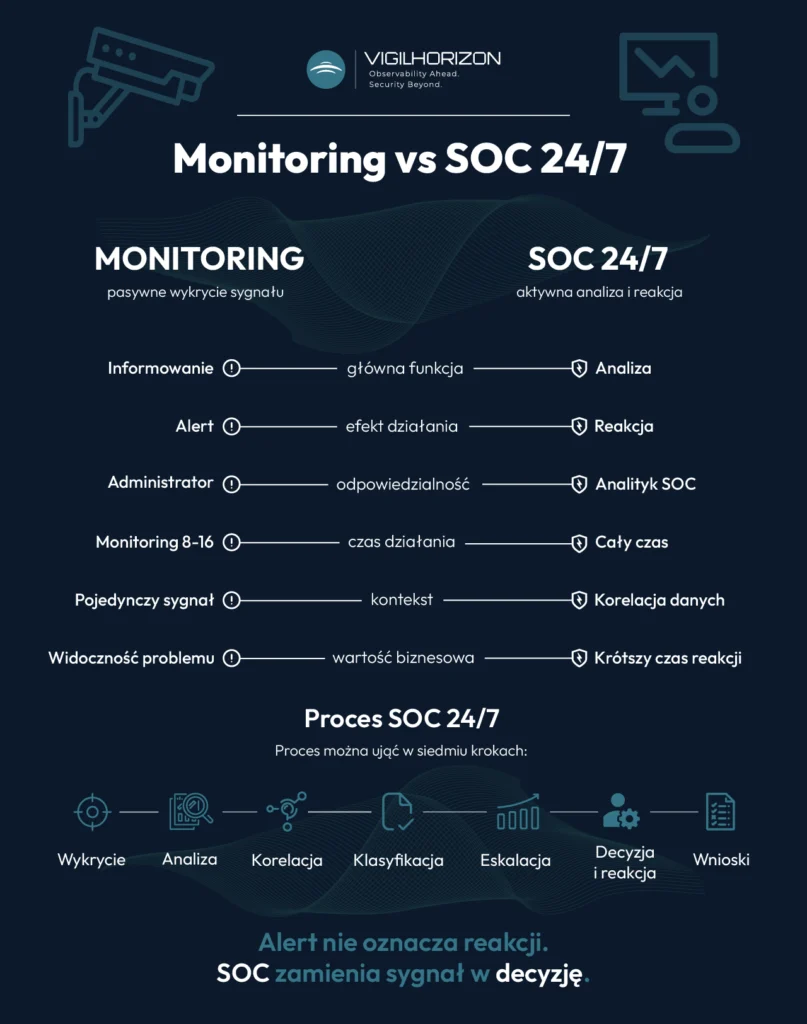
The SOC receives signals from SIEM, EDR, XDR, firewalls, identity systems, email, infrastructure and applications, then determines what happened, how serious it is, which assets are affected and who should respond. The process can be described in several steps:
- Detection —receiving an alert from security or monitoring systems.
- Analysis —checking what the event concerns and whether it indicates an incident.
- Correlation —connecting the individual signal with other data.
- Classification —determining its category, priority and potential organizational impact.
- Escalation —passing information to IT, the system owner, CTO/CIO or those responsible for continuity.
- Response —restricting access, blocking an account, isolating an asset or activating Incident Response.
- Lessons learned —documenting actions and improving rules, playbooks and escalation procedures.
A SOC does not replace IT or management. It helps move more quickly from signal to decision.
In practice, VigilHorizon treats SOC as an operational service, not just a technical one. This means analyst readiness, agreed escalation paths, playbook-based work and accountability for ensuring that alerts become more than system notifications.
What makes up a modern SOC?
A modern SOC is not a list of tools. Owning SIEM, EDR, XDR or SOAR does not itself give a company a security operations center. Combining technology with analysts, playbooks, escalation and incident response creates a real operational capability.
| SOC component | Role in the process | Limitation |
|---|---|---|
| SIEM | Collects and correlates data from multiple sources | Does not make decisions |
| EDR/XDR | Shows endpoint and server activity | Does not replace business escalation |
| SOAR | Automates repetitive tasks | Requires oversight for actions affecting the business |
| Threat Intelligence | Adds threat context | Does not replace knowledge of the environment |
| Playbooks | Reduce improvisation | Do not work without agreed roles |
| SOC analysts | Interpret alerts and recommend actions | Do not replace system owners |
| Escalation procedures | Define who responds and when | Must be understood and tested |
SOC as a Service or an internal SOC should be designed as part of organizational resilience. Monitoring, analysis, escalation, incident response, backup, disaster recovery and business continuity must form one chain of action.
MITRE ATT&CK in SOC practice
In this article, MITRE ATT&CK is best understood as a practical working language for SOC teams, not just a technical encyclopedia of attacks. Its structured knowledge base of adversary tactics and techniques helps security teams describe events through observed behavior, rather than only tool names or individual alerts.
For management, MITRE ATT&CK has a straightforward value: it clarifies the incident’s stage and whether the organization detects only the final impact or earlier warning signs too. For CTOs, CIOs and IT managers, it helps structure SIEM detection rules, EDR/XDR signals, playbooks and incident response.
In practice, a SOC maps alerts to MITRE ATT&CK techniques to determine whether activity involves attempted entry, account misuse, asset discovery, lateral movement, ransomware preparation or interference with recovery. This classification does not replace analysis; it organizes it and supports prioritization.
| Behavior category | Example MITRE ATT&CK technique | What the SOC should see | Significance for the organization |
|---|---|---|---|
| Attempted entry into the environment | Phishing—T1566 | Unusual messages, suspicious links or attachments, and signals from email, endpoints and identity systems | The organization detects an initial-access attempt before it becomes an incident involving internal systems |
| Account misuse | Valid Accounts—T1078 | Unusual sign-ins, account use outside normal working patterns, activity from new locations or devices | An attacker often looks like a legitimate user, so an account appearing in logs alone is insufficient for risk assessment |
| Account and privilege discovery | Account Discovery—T1087 | Attempts to identify users, groups, roles or permissions after gaining access | Early discovery detection signals that an incident is developing from an isolated event into broader attacker activity |
| Movement across the environment | Remote Services—T1021 | Unusual use of remote services, connections between systems and administrative activity outside normal context | Lateral movement raises the risk of an incident spreading to further systems and becoming an operational problem |
| Impact on data availability | Data Encrypted for Impact—T1486 | Signs of mass file changes, unusual data-resource activity, and endpoint and file-system alerts | At this stage, the incident begins to cause downtime, loss of data availability and costly environment recovery |
| Interference with recovery | Inhibit System Recovery—T1490 | Attempts to compromise recovery mechanisms, backups, snapshots or restoration settings | The incident begins to affect not only current systems but also the organization’s ability to resume operations |
Using MITRE ATT&CK this way helps avoid two problems: an overly technical view of an alert—”the system reported something”—and an overly broad view of an incident—”we have a cyberattack.” A SOC needs the middle ground: understanding the behavior detected, its incident stage and the response to consider.
This does not mean every organization must build an advanced detection matrix on day one. Start with the most important business-risk scenarios: phishing, compromised accounts, lateral movement, ransomware and attempts to hinder recovery. Then check whether SIEM, EDR/XDR, playbooks and escalation procedures actually cover them.
For a 24/7 SOC, MITRE ATT&CK structures work: classifying alerts, designing detection rules, building playbooks, reporting incidents and developing incident response. Technique identifiers alone are not what matters most. What matters is whether the organization can turn a signal into a decision and a response.
Monitoring vs. SOC
Monitoring and SOC are related, but distinct. Continuous monitoring provides visibility; the SOC uses that visibility to build a process of analysis, decision and response.
The difference between monitoring and a SOC is not the number of tools, but the ability to analyze, decide and respond. An alert alone does not reduce risk. A process in which someone assesses the event and initiates appropriate action does.
| Area | Monitoring | SOC 24/7 |
|---|---|---|
| Primary function | Event notification | Analysis, classification and escalation |
| Output | Alert | Recommendation or response |
| Responsibility | Administrator or IT | SOC analyst working with IT |
| Operating hours | Often 8 a.m.–4 p.m., on-call duty or a response the next morning | Analysis also at night, on weekends and holidays |
| Context | A single signal | Correlation of data from multiple sources |
| Business value | Visibility of the problem | Less time from detection to action |
Scenario: a cyberattack with and without a SOC
An organization has IT security monitoring, EDR, a firewall and email notifications. At 1:48 a.m., an alert flags unusual account activity. The system works correctly: the event is recorded and the notification enters the queue.
Without a SOC, the alert waits until morning. Meanwhile, attackers can explore resources, search for privileged accounts and prepare their next steps. In the morning, the administrator works under pressure to establish whether the alert is real, which system is affected, who decides and whether to escalate to the CTO, CIO or management. Each hour of uncertainty increases downtime risk.
In a 24/7 SOC model, the same alert reaches an analyst immediately. The SOC checks its source, account activity history, related alerts, SIEM data and EDR/XDR signals. If the event is significant, it assigns a priority and passes it to the right people with context.
The difference lies in timing and information quality. Without a SOC, the company responds to possible consequences. With a SOC, it can restrict access, isolate an asset, block an account or initiate incident response earlier—before a technical problem develops into an operational crisis.
NIS2 and security monitoring
NIS2 reinforces the need to view cybersecurity through organizational risk-management capability, not tools alone. Having monitoring, SIEM, EDR or notifications does not establish whether a company can detect and handle an incident.
NIS2 and security monitoring should be explained in practical terms: who analyzes alerts after hours, who classifies events, who makes decisions and whether the organization can reconstruct the response.
A 24/7 SOC helps structure this area. It does not replace the organization’s responsibility, but provides the operational layer that turns tools into an actual ability to act.
Readiness checklist
| Check question | Answer |
|---|---|
| Are security alerts analyzed 24/7? | YES / NO |
| Does someone assess alert context, not just its contents? | YES / NO |
| Does the organization know who is responsible for incident escalation? | YES / NO |
| Are playbooks in place for the most important scenarios? | YES / NO |
| Do people actively analyze SIEM data? | YES / NO |
| Is EDR/XDR connected to a response process? | YES / NO |
| Does management know which decisions it must make during an incident? | YES / NO |
| Are detection and response times measured, for example through MTTD and MTTR? | YES / NO |
| Has the organization tested its incident response process? | YES / NO |
If most answers are „NO,” technology is not the only problem. The organization lacks a complete process from detection through analysis and escalation to decision and response.
Do you know what happens after an alert in your company?
If your organization has monitoring, SIEM or EDR/XDR but does not know who analyzes alerts 24/7 or when they activate Incident Response, assess readiness before a real incident.
Reference model: from alert to response
| Stage | Objective | Risk if the stage fails |
|---|---|---|
| 1. Event | Record unusual activity | The event remains invisible |
| 2. Analysis | Check the alert’s context | The alert is treated as noise |
| 3. Correlation | Connect signals from multiple sources | The organization does not understand the incident’s scale |
| 4. Classification | Determine severity and priority | Response is too slow or disproportionate |
| 5. Escalation | Route the case to the right people | Information arrives too late or reaches the wrong person |
| 6. Decision and response | Limit the incident’s consequences | The attack continues despite detection |
| 7. Lessons learned | Document actions and improve the process | The organization repeats the same mistakes |
This model shows that a 24/7 SOC is more than a technical function. It organizes work where time, context and accountability affect business continuity.
That is why VigilHorizon focuses on responsibility for handling an event, as well as tools. The organization should know who analyzes it, who recommends action, who decides and how actions are documented afterward. This distinguishes monitoring alone from a mature SOC service.
What should IT and management do?
A 24/7 SOC works effectively only when connected to clear accountability within the organization.
Recommendations for IT
- Organize log and alert sources: SIEM, EDR/XDR, firewalls, identity, email, infrastructure and critical applications.
- Link alerts to escalation: who receives the case, within what timeframe and with which information.
- Prepare playbooks for account compromise, EDR alerts, suspected ransomware and unusual administrative activity.
- Measure MTTD and MTTR to check whether the process reduces the attacker’s operating window.
Recommendations for management
- Set acceptable risk levels and response times for critical systems.
- Assign decision-making roles: who approves system isolation, communications and emergency procedures.
- Connect SOC, incident response, backup, disaster recovery and business continuity into one resilience model.
- Check that procedures are understood and practiced, not just documented.
Detecting an incident is insufficient if the company does not know how to limit its consequences and restore operations.
Summary
The key question is not whether the organization has monitoring. It is whether someone analyzes alerts, understands their context and has the authority and procedure to initiate a response while a cyberattack is developing.
IT security monitoring is necessary, but without analysts, escalation, playbooks and incident response it mainly provides visibility. A 24/7 SOC turns visibility into action: analysis, classification, decisions, response and post-incident lessons.
Frequently asked questions (FAQ)
What is a SOC?
A SOC is a security operations center responsible for monitoring, analyzing, classifying and escalating cybersecurity events.
What is a 24/7 SOC?
A 24/7 SOC provides event analysis around the clock, including nights, weekends and holidays.
How does monitoring differ from a SOC?
Monitoring generates alerts. A SOC assesses their significance, correlates signals, classifies the event and supports response.
Is SIEM or EDR enough to stop a cyberattack?
No. SIEM and EDR provide data, but do not replace analysts, playbooks, escalation and incident response.
Does every company need a 24/7 SOC?
Not every company needs the same SOC model, but every company should know how it handles incidents outside business hours.
What is SOC as a Service?
It is a model in which an external partner provides event analysis, escalation, reporting and response support.
How does a SOC support NIS2 requirements?
A SOC helps demonstrate the ability to detect, analyze, escalate and document incidents, but does not replace risk management.
Does a SOC mean the high cost of an internal team?
Not always. SOC as a Service provides 24/7 analysis without the company building a full shift-based team.
How should a SOC work with IT?
The SOC analyzes and escalates events, while IT performs agreed technical actions under the playbooks.
Where should SOC implementation begin?
By checking which systems generate alerts, who analyzes them, whether coverage extends beyond business hours and how escalation works.
Learn more
- SOC 24/7
- SOC, NOC and observability
- NIS2 and security monitoring—which requirements really apply?
- Incident response—what does responding to a cyberattack involve, step by step?
- SIEM in your company — why deployment alone does not improve security
- EDR, XDR and MDR — how they differ and when they protect your business
- MTTD and MTTR — why detection time determines incident impact
Related articles



Not sure which plan is right for your business?
Complete a short questionnaire
Complete the form and we will help you select monitoring, incident handling or availability support for your organisation. We will agree the scope and service conditions before work begins.
Sources and update scope
Content and link update: 15 October 2026. Response conditions, the illustrative nature of scenarios and source references have been clarified. This date does not indicate independent legal review or confirmation of an organisation’s compliance.