
EDR, XDR and MDR — how they differ and when they protect your business
18 March 2026

A company deploys EDR on workstations and servers. It detects anomalies and generates alerts, so management hears that endpoints are protected. The problem emerges when a critical signal appears outside business hours or gets lost among less important events.
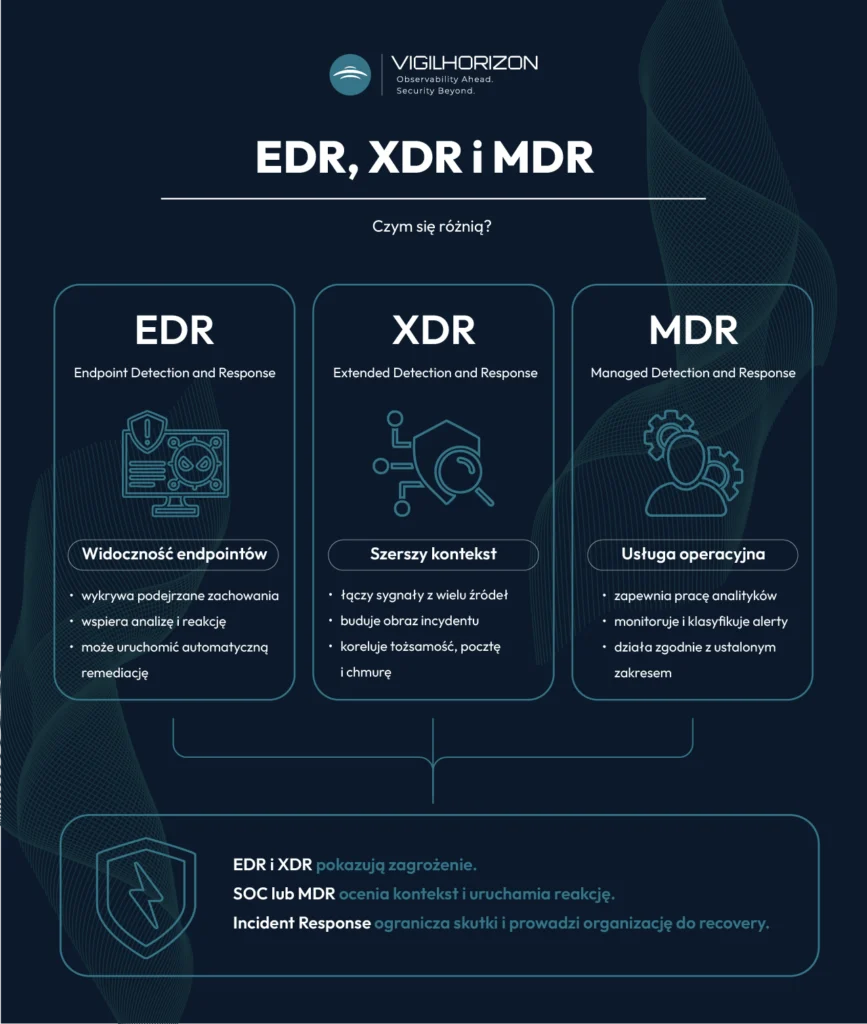
EDR can detect and automatically block some activity. XDR can connect the signal with email, identity and cloud data, while MDR can provide an analysis team. None of these terms automatically means permissions, playbooks and response are ready. The choice is therefore about an operating model, not just a license.
What should you know?
- EDR focuses on endpoints. It provides detailed telemetry, detection and response capabilities on devices, but does not always reveal the full attack beyond them.
- XDR broadens context. It combines signals from several security domains, but still requires configuration, analysis and a decision-making process.
- MDR is a service. It provides analysts and an agreed monitoring and response scope; its actual value depends on the contract, permissions, SLA and connected data sources.
- An alert does not end an incident. Classification, decisions, containment, eradication of the cause and recovery are what limit an attack’s consequences.
- EDR alone does not provide NIS2 compliance. It can support appropriate technical measures, but does not replace risk management, incident handling, business continuity and documentation.
The company had EDR. Why wasn’t the attack stopped?
On Friday evening, EDR detects an unusual script, an attempt to obtain credentials and a connection to unknown infrastructure. Events are visible, but no formal on-call coverage exists. The administrator sees the alert in the morning, after the attacker has used the compromised account for further activity.
EDR did not fail—it recorded the signals. The operating model failed because nobody was responsible for connecting events, assessing impact and deciding on device isolation or account blocking. This distinction between visibility and response capability is also illustrated by the case where a company had EDR but still suffered ransomware.
Management should ask not only „Do we have EDR?” but also who watches alerts, how quickly they distinguish incidents from noise and what authority they have.

Why has EDR become the standard for endpoint protection?
Workstations and servers are important sources of attack information: processes run commands, access memory and operate on files there. Traditional antivirus focuses primarily on prevention, while EDR adds continuous telemetry, behavioral analysis, investigation and response.
The team can reconstruct which process performed an action, under which account and what happened next. EDR does not resolve every incident by itself, but provides endpoint visibility. Its value depends on device coverage, policies, exclusions and alert tuning.
What is EDR, and where does its role end?
Endpoint Detection and Response monitors endpoints, detects suspicious behavior and supports analysis and response. Depending on the product, it can stop a process, quarantine a file, isolate a device or initiate automated remediation.
Automation follows rules and cannot resolve every business decision, such as whether to disconnect a critical server. EDR sees a great deal on endpoints, but an attack may simultaneously involve email, identity, SaaS, networks and cloud services.
EDR monitoring also needs a process owner. Someone must maintain policies, investigate alerts, document decisions and verify automated response outcomes. Without this, the tool provides potential, not certainty of action.
What is XDR, and what does broader correlation offer?
Extended Detection and Response expands analysis beyond endpoints. It combines data from devices, email, identity, cloud and networks to build one incident from multiple signals. An unusual sign-in, an email click and script execution can then be assessed as one sequence.
However, not every XDR sees the entire environment. Scope depends on sources, integration quality and licensing. If a critical application sends no data, the product name will not remove the blind spot.
Does XDR replace SIEM?
XDR usually correlates supported security domains, often within a vendor ecosystem. SIEM can aggregate a broader range of logs and provide retention, reporting and custom rules. Their functions overlap, but both can work together. Deploying SIEM alone does not improve security if correlation is not followed by analysis and response.
Does XDR replace a SOC?
No. XDR is a platform; a SOC is a capability built from people, processes and technology. XDR accelerates analysis but does not establish duty shifts, accountability, escalation or business communication.
What is MDR, and why is it a service rather than a product?
Managed Detection and Response is a service providing detection, analysis and agreed response through an external team. The provider uses EDR, XDR or SIEM, but analysts and the client cooperation process are central.
Before purchasing, check not only technology but also 24/7 availability, data sources, triage, escalation times and containment authority. MDR can use provider or client tools, and services sold under the same name may differ greatly.
Is MDR the same as a SOC?
They are not exact synonyms. A SOC is an organizational function combining a team, procedures and technology. MDR delivers an agreed set of these activities as a service and can supplement or partly replace internal staffing.
EDR vs. XDR vs. MDR—the key differences
The differences come down to three questions: where does the data come from, who analyzes it and who is authorized to respond? EDR and XDR mainly describe technological capabilities. MDR describes a service in which a team operates those capabilities under an agreed process.
| Feature | EDR | XDR | MDR |
|---|---|---|---|
| Core nature | endpoint protection technology | a platform correlating several security domains | a managed detection and response service |
| Main data sources | workstations, servers and other endpoints | endpoints, identity, email, cloud and network, depending on integrations | contracted sources, often EDR/XDR/SIEM |
| Incident context | in-depth on the device | broader, across domains | enriched by human analysis and client procedures |
| Expert analysis | the organization’s responsibility | the organization’s responsibility | part of the service, within its scope |
| Automated response | available for some scenarios | available for some scenarios and domains | depends on technology and provider permissions |
| Operational response | requires a process owner | requires a process owner | agreed in the contract and playbooks |
| 24/7 monitoring | does not follow automatically from buying a license | does not follow automatically from buying a license | should be explicitly confirmed in the service scope |
| Greatest risk | lack of context beyond the endpoint and unhandled alerts | integration gaps and a false sense of complete visibility | unclear scope, limited permissions or slow escalation |
Choosing EDR or XDR should not become a simple ranking exercise. EDR may suit a simpler environment with a sound security process. XDR can offer significant advantages when attacks cross several domains. MDR may be needed in either case if continuous staffing and analysis expertise are missing.
Why can’t EDR stop a cyberattack on its own?
Automated blocking cannot make every decision for an organization. Some events are ambiguous, and disconnecting a user’s workstation carries different risk from isolating a critical server. The threat, scope and impact must be confirmed before choosing account blocking, device isolation, traffic restrictions or crisis procedures.
Expert comment: „EDR can detect an attack and perform some actions automatically, but someone must still determine whether an alert is an incident, how far it extends and which response the organization can activate without losing control of its business.”
After containment, the cause must be eliminated, other systems checked, operations restored and the sequence documented. This is structured by the incident response process.. Detection and response times must be measured across the whole process, not only until an alert is generated.
What does a reference protection model look like?
Some platforms combine EDR, XDR and SIEM and automate parts of response. The operational logic remains similar: a signal must be enriched, assessed and converted into controlled action.
| Layer | Role | Check question | What happens if this layer is missing? |
|---|---|---|---|
| EDR/XDR | telemetry, detection, investigation and response capabilities | Are all critical assets and domains covered? | some activity is invisible or lacks context |
| SIEM / correlation | combining data from multiple systems, retention and rules | Can the alert be linked to identity, network and application data? | events remain scattered and analysis takes longer |
| SOC / MDR | 24/7 triage, classification, escalation and coordination | Who analyzes the alert, and within what timeframe? | the signal waits for an available administrator |
| Incident Response | containment, eradication, communications and decisions | Who can isolate, block and activate the procedure? | the team improvises and response is delayed |
| Recovery | safe restoration of operations and verification | How can operations resume without reactivating the threat? | the incident may recur or downtime may lengthen |
VigilHorizon treats EDR and XDR as signal sources, not a complete security model. SOC 24/7 shortens the path from alert to decision through continuous analysis, classification and escalation.
Check whether the tool is connected to response
A console’s feature list cannot tell you what will happen during an incident. Run a simple operational test: generate a controlled signal and check acknowledgment time, classification, escalation and the availability of an authorized decision-maker. Such tests often expose gaps missing from deployment documentation.
If critical alerts wait until morning, the playbook does not define isolation scope and the team does not know where automation ends, the issue is no longer EDR versus XDR. It is the absence of a ready process. In this situation, VigilHorizon SOC 24/7 can complement existing technology with continuous analysis, escalation and response under agreed scenarios, without treating another tool purchase as an end in itself.
When should you choose EDR, XDR or MDR?
EDR—when endpoints are the priority
EDR is a suitable starting point for a company seeking workstation and server telemetry and response, with a relatively simple environment and a team capable of operating it. Full coverage, suitable policies and duty coverage are prerequisites; license counts alone are not enough.
XDR—when incidents cross security domains
Consider XDR when attacks involve email, cloud and identity, and analysts manually connect data from multiple consoles. Verify coverage of the actual architecture. Supported use cases matter more than the number of integration logos.
MDR—when continuous staffing or operational expertise is missing
MDR makes sense when a company has technology but cannot provide 24/7 analysis, investigation or rapid response. Before signing, verify sources, operating hours, permissions and incident cooperation. Simply forwarding notifications may not solve the problem.
When is a combination needed?
A combination is often needed: EDR or XDR provides technology, SIEM adds visibility, and MDR or an external SOC provides operations. The decision should follow risk, architecture and team availability.
Before choosing, hold a workshop covering critical assets, telemetry sources, team availability and actions requiring business approval. This reveals whether the gap concerns visibility, correlation or operations, and avoids buying features the organization cannot use.
Is EDR enough to meet NIS2 requirements?
No. NIS2 does not require purchasing a product called EDR. It requires appropriate and proportionate risk-management measures, including incident handling, business continuity and assessment of control effectiveness.
EDR supports these through telemetry, detection and endpoint response, but a license does not prove effectiveness. Device coverage, accountability, alert analysis, escalation, documentation and procedure testing must be demonstrated. This approach is explored in NIS2 and security monitoring—what the Directive actually requires.
Compliance assessment must consider the organization’s status, applicable law and the adequacy of measures. This article does not replace legal or technical analysis.
The same EDR, two different incident outcomes
The following scenario is hypothetical but reflects a typical difference between owning a tool and being operationally ready.
In the first version, EDR detects an attempt to obtain credentials at 2:13 a.m., but the administrator checks the queue in the morning. There is no backup coverage or person authorized to block the account. Analysis starts hours after the signal.
In the second version, the alert reaches a 24/7 SOC. An analyst links it to a sign-in and network traffic, activates the playbook, isolates the workstation within the agreed scope and escalates the incident. The technology is similar; timing, context and readiness differ.
Common mistakes after EDR or XDR deployment
- No process owner. Nobody owns the full journey from configuration and alert queues to incident closure.
- No 24/7 monitoring. The console runs around the clock, but alerts wait for an available administrator.
- Incomplete coverage. Unmanaged devices, disabled policies and missing integrations create blind spots that an XDR label cannot remove.
- No tuning. Excessive alerts without asset-criticality context lead to alert fatigue and poorer analysis.
- No playbooks or permissions. An analyst recognizes an incident but does not know whether they may isolate a device or block an account.
- Excessive trust in automation. Automated actions need testing and oversight because they can disrupt work or leave a threat in place.
- No incident response or recovery. Isolating a device does not end an attack if the attacker retains another account or access mechanism.
Summary
EDR provides endpoint visibility and response, XDR connects signals across domains, and MDR delivers analysis as a service. A company is protected when an alert initiates a predictable process: assessment, decision, containment, eradication and recovery.
If you are unsure whether EDR or XDR is monitored 24/7 and who will decide during an incident, find out before an attack. VigilHorizon can provide a security architecture consultation, assess the current model and complement it with 24/7 SOC monitoring and response. The goal is a shorter path from signal to action, not another console.
Frequently asked questions (FAQ)
Does EDR replace antivirus?
They are not always separate products. Many platforms combine antivirus and EDR. Antivirus focuses on prevention, while EDR adds telemetry, investigation and response; scope depends on the solution.
EDR or XDR—which should you choose?
EDR focuses on endpoints. Consider XDR when incidents also involve email, identity and cloud services. Use cases, integrations and operational capability should guide the decision.
Does XDR replace SIEM?
Not automatically. XDR correlates supported domains, while SIEM can cover broader logs, retention and custom rules. Base the decision on data and requirements.
Does XDR replace a SOC?
No. XDR is a platform, while a SOC combines a team, processes and tools. XDR assists a SOC but does not create duty coverage, accountability or playbooks.
Is MDR the same as a SOC?
MDR can perform some SOC functions, but service scopes vary. Check 24/7 availability, data sources, permissions, SLA and cooperation arrangements.
Is EDR enough to meet NIS2 requirements?
No. EDR supports detection and response, but NIS2 requires broader risk management, incident handling, business continuity, effectiveness assessment and documentation.
Can EDR stop an attack automatically?
It can block activity, isolate devices or perform remediation. Not every decision is suitable for automation, particularly when critical systems are affected.
Does every company need XDR?
No. In a simpler environment, good EDR and a mature process may suffice. XDR becomes more valuable as domains multiply and shared correlation is needed.
How should you choose an MDR service?
Compare data sources, monitoring hours, analyst expertise, triage and escalation times, containment permissions and incident cooperation.
Who should analyze EDR alerts?
An internal team or an MDR/SOC provider can do so. Responsibility must be assigned, staff available when required, and analysts equipped with context and an escalation path.
Learn more
- What is SOC 24/7? How a Security Operations Center works and why monitoring is not enough
- SIEM in your company — why deployment alone does not improve security
- Incident Response: responding to a cyberattack step by step
- NIS2 and security monitoring—what the Directive actually requires
- MTTD and MTTR — why detection time determines incident impact
- The VigilHorizon SOC 24/7 plan
Related articles



Not sure which plan is right for your business?
Complete a short questionnaire
Complete the form and we will help you select monitoring, incident handling or availability support for your organisation. We will agree the scope and service conditions before work begins.