
Incident response—what does responding to a cyberattack involve, step by step?
3 December 2025
Cyberattacks cannot be eliminated entirely. An organization reduces risk and monitors its environment, but should not assume it will never experience an incident.
Resilience depends on more than firewalls, EDR, SIEM or backups. Above all, it depends on how quickly the organization detects threats, who makes decisions and whether consequences are contained before affecting the business.
Incident Response is a structured process for responding to security incidents. It is neither a single tool nor something started only after an attack.
Useful insights
- Incident response is a process, not a tool. It includes preparation, detection, analysis, classification, containment, eradication, recovery and lessons learned.
- EDR, SIEM and backups are not enough without decisions. An alert must be interpreted, classified and turned into action.
- Response time has a business impact. Long MTTD and MTTR increase the risk of downtime, data loss and confused communication.
- Effective IR begins before an incident: with roles, playbooks, escalation, monitoring and exercises.
- IR aims for a fast, proportionate and documented response, rather than improvised action under pressure.
Cyberattacks do not wait for a convenient moment
It is 2:13 a.m. EDR detects suspicious activity on a file server. A user account starts accessing unfamiliar resources. The on-call administrator must decide: disconnect the server, block the account, escalate to management or gather more data first?
This reveals the difference between an organization that „has security tools” and one with a prepared response process. An alert does not decide. SIEM does not know which systems are critical. EDR does not establish who may stop a business service.
Without a process, the first minutes are spent establishing basics: who decides, who knows the system, who communicates with the business and who documents actions. Such confusion often means longer downtime, data loss or flawed communication.
What is incident response?
Incident Response is the process of responding to security incidents. It aims to detect a threat, assess the situation, contain consequences, eliminate the cause and safely restore IT operations.
IR answers: what happened, how serious is it, which systems are affected, who should be involved, what must happen immediately, what should be avoided and what lessons should follow?
Professional IR combines people (SOC, IT, CTO/CIO, management and system owners), procedures (playbooks, classification, escalation and documentation) and technology (EDR/XDR, SIEM, logs, monitoring and backup). A company can have tools yet remain unprepared if nobody analyzes alerts after hours and no clear escalation path exists.
VigilHorizon’s starting point is not simply deploying a tool, but establishing how the organization works under pressure: who watches the environment, analyzes alerts, escalates events and owns technical and business decisions. Technology matters, but processes, people and accountability create response capability.

The consequences of having no process: why is incident response a business priority?
Lack of incident response is not just an IT problem. It creates operational risk that translates into downtime, delayed customer service, data loss, expensive recovery, reputational risk and difficulty demonstrating decisions made during an incident.
The biggest cost is often not the alert itself but time lost improvising. If a company establishes decision-making, communications and backup use during an attack, consequences grow with every hour.
For management, IR is part of operational resilience; for CTOs and CIOs, an incident-management model; for IT managers, a practical way to work under pressure.
Why does response time determine incident scale?
Time is a major risk factor in a cyberattack. The longer the organization does not understand what is happening, the more room the attacker has. Typical activity includes privilege escalation, network movement, data exfiltration, encryption or preparation to attack backups.
Two metrics matter in IR: MTTD and MTTR. MTTD means the time needed to detect a threat. MTTR refers to the time needed to respond, contain consequences or restore operations.
| Metric | What it measures | Business significance | What helps improve it |
|---|---|---|---|
| MTTD | Time from threat occurrence to detection | Long undetected periods increase escalation and data-loss risk | Monitoring, SIEM, EDR/XDR, event correlation and a 24/7 SOC |
| MTTR | Time from detection to response or restoration | Slow response increases business-process impact and cost | Playbooks, roles, escalation, exercises and a prepared IR process |
Low MTTD offers little value if the organization does not know what to do after detection. Timely detection requires tools, people, event correlation, classification and escalation. That is why SOC 24/7 is an important component of mature IR.
In the first minutes of a cyberattack, the organization’s greatest enemy is often unclear decision-making rather than a lack of tools. Mature incident response shortens the path from alert to the right decision.
Speed without a process can be as risky as delay. The right response should be fast, proportionate and documented.
Reference model: seven stages of professional incident response
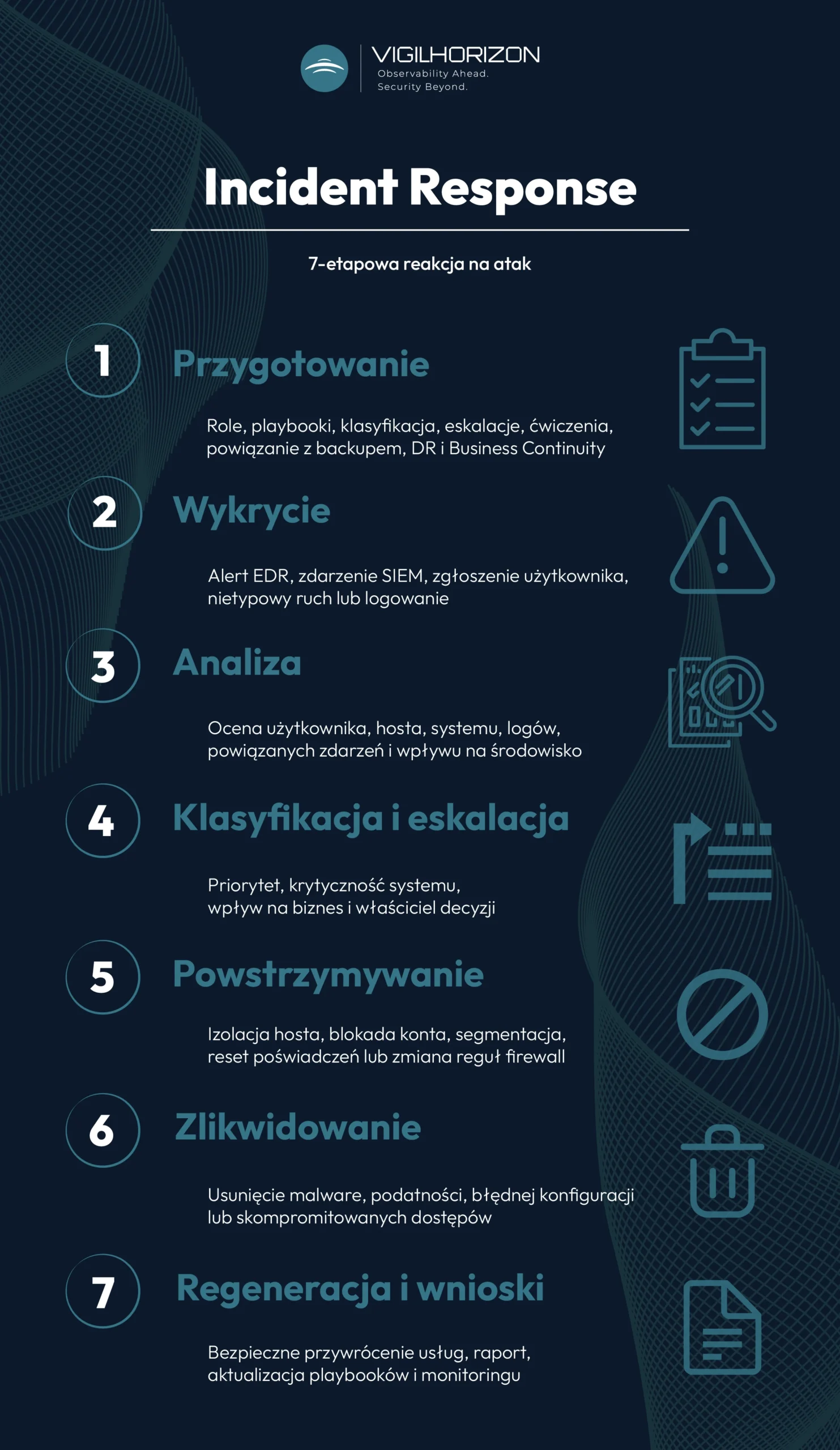
Professional incident response is a sequence of decisions and actions established before an incident. Not every incident is linear, but the organization should share a common model.
| Stage | What it includes | Organizational outcome |
|---|---|---|
| Preparation | Roles, playbooks, classification, escalation, exercises and links to backup, DR and business continuity | Less improvisation and faster response |
| Detection | An EDR alert, SIEM event, user report, unusual traffic or sign-in | The organization recognizes a potential incident |
| Analysis | Assessment of the user, host, system, logs, related events and environmental impact | Fewer false alarms and better decisions |
| Classification and escalation | Priority, system criticality, business impact and decision owner | It is clear who needs to be involved |
| Containment | Host isolation, account blocking, segmentation, credential resets or firewall-rule changes | Reduced damage |
| Eradication | Removing malware, vulnerabilities, misconfiguration or compromised access | Lower risk of the attack returning |
| Recovery and lessons learned | Safe service restoration, reporting and updates to playbooks and monitoring | Return to business and improved readiness |
This process shows that IR does not end with disconnecting a host or restoring a backup. It includes preparation, technical and business decisions, and post-incident improvements.
Professional IR support should therefore cover not only SIEM, EDR/XDR or monitoring-rule configuration, but also teamwork, cooperation with a 24/7 SOC, playbooks, escalation and decision records. VigilHorizon provides this as one operational capability rather than separate tools.
Roles and responsibilities during an incident
Even the best playbook is ineffective if nobody knows who analyzes alerts, makes technical decisions, assesses business impact and informs management.
- SOC —detection, analysis, alert correlation, classification and escalation.
- IT / administrators —asset isolation, account blocking, log preservation and recovery.
- CTO / CIO —technical and operational priorities, connecting IT actions with business continuity.
- Management —business decisions and risk acceptance, especially when customers, data, reputation or costs are affected.
- System owners —assessment of business-process impact.
- Compliance / legal / communications —documentation, reporting obligations and communications.
Well-designed IR clarifies accountability for analysis, technical decisions, business impact, communications and compliance.
For VigilHorizon, response accountability also means predictable cooperation: clear contact channels, agreed escalation levels, a common language across SOC, IT and business, and reporting that reconstructs decisions after an incident.
The same incident—two different paths
An organization without prepared IR
A company has a firewall, EDR, backups and centralized logging. On Friday evening, a user opens a phishing attachment. EDR generates an alert, but nobody analyzes it immediately because IT works normal hours. In the morning, the administrator sees several alerts but cannot tell whether the incident is critical. Management learns of the problem only when users report unavailable files.
An organization with prepared IR
In a similar scenario, the alert reaches the SOC and is analyzed alongside logs from other systems. A playbook guides classification. The administrator receives technical recommendations, the CTO/CIO receives environmental-impact information, and the system owner assesses the consequences of isolation.
| Area | Without prepared IR | With prepared IR |
|---|---|---|
| Detection | The alert is noticed late | The alert is analyzed under the procedure |
| Decisions | Nobody knows who decides | Roles and escalation are established in advance |
| Communication | IT, management and business have different information | Communication follows an agreed structure |
| Containment | Actions are late or too broad | Consequences are contained proportionately |
| Recovery | Recovery takes place under pressure | Service restoration is linked to root-cause analysis |
| Lessons Learned | No report or process improvements follow | Lessons update procedures |
Common organisational mistakes
- No playbooks —the team designs its response during the incident.
- Unclear responsibility —it is unclear who approves actions affecting the business.
- No incident classification —the organization responds too slowly or escalates too widely.
- Monitoring without operational coverage —alerts exist, but nobody analyzes them in time.
- No exercises —the procedure remains an assumption rather than an operational capability.
- Recovery without root-cause analysis —restoring a backup without investigating the cause risks restoring the problem along with the environment.
- No documentation —decisions and accountability are difficult to reconstruct afterward.
How should an organization prepare?
Preparation need not mean building a large security team on day one. What matters is a practical ability to detect, understand and handle an incident.
- Define an incident —identify critical systems, protected data, events requiring escalation and when management becomes involved.
- Assign roles —establish who analyzes alerts, makes decisions, communicates with the business and documents actions.
- Prepare playbooks —start with ransomware, account compromise, malware, data breaches and critical-system incidents.
- Provide analysis outside business hours —through internal on-call coverage, SOC 24/7 or a hybrid model.
- Connect IR to backup, DR and business continuity —define recovery priorities, backup validation and service-restoration decisions.
- Establish communications —identify who informs management, system owners, employees, customers and partners.
- Exercise and update the process —tabletop exercises reveal whether procedures are workable.
For NIS2, the ability to detect, handle, document and report incidents matters. IR therefore supports both operational resilience and compliance.
Test readiness before an incident does
If the organization does not know who analyzes alerts, who makes decisions or how escalation works after hours, operational readiness has not been established.
VigilHorizon helps companies build this capability: from SOC 24/7, through structured alert handling, to the SOC, NOC and observability model. A security assessment is a good first step.
Incident response readiness checklist
| Check question | Answer |
|---|---|
| Has the organization defined a security incident? | YES / NO |
| Does security monitoring operate 24/7? | YES / NO |
| Are alerts analysed outside working hours? | YES / NO |
| Is it clear who authorises account, host or system isolation? | YES / NO |
| Are playbooks in place for ransomware, compromised accounts and data breaches? | YES / NO |
| Does the SOC receive SIEM, EDR/XDR and identity data? | YES / NO |
| Are MTTD and MTTR measured or assessed? | YES / NO |
| Is IR connected to backup, DR and business continuity? | YES / NO |
| Is it clear when to escalate to the CTO, CIO or management? | YES / NO |
| Are incident actions and decisions documented? | YES / NO |
| Have IR procedures been exercised with IT, security and decision-makers? | YES / NO |
| Is there an agreed cooperation model with the SOC or security partner? | YES / NO |
If most answers are „NO,” the problem is more than missing tools. It is a lack of operational readiness to detect, classify and handle incidents under time pressure.
Summary
Professional cyberattack response does not begin when ransomware encrypts data and management asks when the company will recover.
It starts earlier: deciding who analyzes alerts, which systems are critical, how playbooks work, who communicates with the business, how after-hours monitoring operates and how IR connects to backup, DR and business continuity.
Cyberattacks cannot be eliminated entirely. Organizations can, however, limit consequences, shorten response times and reduce confusion. If the biggest risk is an absent process, assess it before a real attack.
Frequently asked questions (FAQ)
What is Incident Response?
The security incident response process: preparation, detection, analysis, classification, containment, eradication, recovery and lessons learned.
Is EDR or SIEM enough?
No. Tools help detect events but do not replace analysis, escalation and business decisions.
How does incident response differ from a SOC?
A SOC monitors, analyzes and escalates alerts. IR also covers IT and business decisions, containment, recovery, communications and post-incident lessons.
Can incident response be outsourced?
Partly—for example, monitoring or SOC support. The company still needs system owners, business decision-makers and escalation paths.
Is backup enough after ransomware?
No. Assess the incident’s cause, backup condition, risk of renewed compromise and business priorities.
Backup vs. recovery—what is the difference?
A backup is a copy of data. Recovery is a controlled restoration of services, with validation that the same problem is not being restored.
When should management be involved?
When an incident affects continuity, customers, data, reputation, regulatory matters or costs. Management makes business decisions.
What are signs of an incident?
Unusual sign-ins, privilege increases, suspicious processes, mass file access, EDR/XDR alerts, SIEM anomalies or user reports.
Is incident response related to NIS2?
Yes. IR supports detection, handling, escalation and documentation of incidents. Read more: NIS2 and security monitoring.
How often should IR procedures be tested?
Regularly, especially after IT-environment changes, new system deployments, organizational changes or an incident.
Related articles and services
Related articles



Not sure which plan is right for your business?
Complete a short questionnaire
Complete the form and we will help you select monitoring, incident handling or availability support for your organisation. We will agree the scope and service conditions before work begins.