
A cyberattack on a manufacturer: from phishing to halted production
27 September 2026

What does an attack on a manufacturing company involve? Explore a realistic scenario and how security monitoring and SOC help limit impact.
Monday, 7:30 a.m. Employees start the first shift. The machines work, but the production plan does not synchronize with MES. At 9:12, planning loses its ERP connection. At 9:35, the line stops because the plant cannot confirm orders, recipes or safe process continuation.
At 10:20, the team establishes that the attack began the previous evening through an employee account. Nobody connected the overnight IT signals into an incident. Production stopped not because machines were directly controlled, but because IT, planning and OT dependencies could no longer be trusted.
This is an illustrative but realistic scenario. It shows how a cyberattack on a manufacturer can unfold and why data loss may not be the biggest consequence. Process interruption, unfulfilled orders, logistics delays and uncertainty about a safe restart may be much more serious.
Key points:
- A cyberattack on manufacturing can start in an ordinary office environment through phishing, a compromised account, remote access or an unremediated vulnerability.
- Stopping production does not require compromising a controller. Unavailable ERP, MES, identity services, recipes or logistics communications can prevent safe operation.
- IT and OT have different priorities. Process safety, availability and predictable changes are paramount in OT, so response must be agreed with production.
- 24/7 monitoring limits consequences only when signals are analyzed, correlated and lead to decisions and incident response.
- Resilience requires two capabilities: early detection and response, and proven recovery in an order determined by production needs.
An illustrative cyberattack scenario at a manufacturing plant
This scenario does not describe a VigilHorizon client or incident. It illustrates dependencies and decisions, without instructions for carrying out an attack.
The previous evening—initial access
An office employee opens a phishing message. Alternatively, initial access could come through a compromised VPN account, a vulnerable service or poorly protected supplier access. This alone does not stop the plant, but opens a path into part of the IT environment.
Night—reconnaissance and expanding access
Unusual sign-ins and cross-system activity appear. The attacker looks for accounts and dependencies that increase their influence. They need not attack OT: identity services, servers, backups, ERP or administrative workstations may become targets.
7:30 a.m.—the production shift starts
No clear incident is visible on the shop floor. Planning data does not arrive correctly, and the first tickets resemble an integration issue. Helpdesk, automation engineers and IT do not yet know the common cause.
9:12 a.m.—ERP stops supporting operations
Planning cannot confirm orders, materials or batch status. Control systems may still work, but the plant cannot be sure production meets the plan, quality standards and traceability requirements.
9:35 a.m.—the line stops
The shutdown may be a protective measure, not the result of a controller change. When the company cannot trust data, accounts or IT/OT connections, continuing may put people, equipment, quality or products at risk.
10:20 a.m.—the incident proves older than the outage
Analysis connects morning reports with overnight activity. The organization determines isolation scope, decision owners and recovery order. As time passes, more systems need checking.
| Stage | What happens in the organization | Possible production impact |
|---|---|---|
| Initial access | a compromised account or exploited IT vulnerability | no visible impact, but risk begins |
| Discovery | searching for accounts, servers and trust relationships | more systems require verification |
| Expanding access | activity on servers, identity systems, ERP or backups | loss of trust in data and services supporting the plant |
| Approaching the OT boundary | attempts to use connections, accounts or administrative workstations | risk to segmentation and safe process operation |
| Visible incident | unavailable ERP, MES, data or services | reduced or halted production |
| Response and recovery | isolation, analysis, remediation and restoration | downtime continues until safe restart is confirmed |
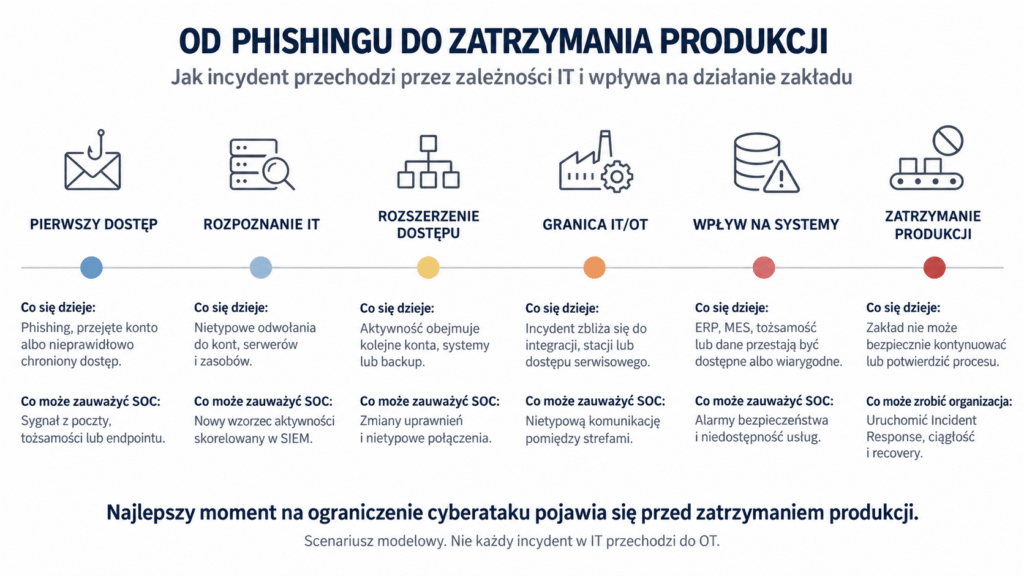
Why manufacturers are attractive targets
Manufacturing faces intense availability pressure. Each hour of downtime affects production lines, employees, materials, orders and logistics. This can encourage restoring systems before the organization fully understands the incident.
A plant connects many layers. ERP handles orders and planning, MES execution and production data, and SCADA process supervision. Integrations, servers, accounts, engineering workstations and remote maintenance connect them.
OT equipment often has a long lifecycle, and updates require testing, a production maintenance window and sometimes manufacturer support. Security programs must therefore account for availability and process risk.
The objective may be extortion, data theft or disruption. For management, maintaining and restoring critical processes matters more than the attack’s label.
How an attack begins
Phishing is an understandable starting point, but not the only one. Initial access may result from stolen credentials, an internet-facing vulnerability, a poorly secured VPN, a partner account or an inadequately maintained device.
Initially, activity may resemble legitimate use: an account signs in at an unusual time, from a new device or accesses a new resource. Account history, asset criticality and other events give the signal meaning.
Controls reduce likelihood, but an email filter may let a message through, MFA may have an exception, and an EDR alert may wait for analysis. A detection and response process is still necessary.
What happens in the IT environment
After gaining access, an attacker tries to understand the environment and expand their capabilities. Indicators include unusual account use, new access, privilege escalation attempts and changes around recovery mechanisms.
Identity systems connect users, devices and permissions. Losing trust in administrative accounts makes it harder to determine which credentials to change and which systems to trust.
ERP holds orders, inventory and planning, so its unavailability can halt operations without touching automation. Compromise of backup systems adds uncertainty: backup integrity and a safe recovery point must be confirmed.
This is where detection time begins to have business consequences. The longer activity remains unexplained, the more accounts, hosts, logs and dependencies must later be verified. The article MTTD and MTTR — why detection time determines incident impact explains why an alert’s timestamp is not the same as the start of an effective response.
When OT becomes at risk
Not every manufacturing cyberattack reaches control systems. Good segmentation, controlled connections, separate identities and restricted remote access can stop progression at the IT/OT boundary. Sometimes production stops despite intact controls because business data and services are unavailable.
OT risk increases with uncontrolled cross-zone connections, shared accounts, multipurpose workstations, permanent supplier access or rules left after maintenance. Devices connecting the two environments become particularly important: integration servers, historians, engineering workstations, reporting systems and remote maintenance mechanisms.
IT and OT have different response priorities. Isolating an office laptop may be routine. Suddenly disconnecting an OT component without process knowledge may make matters worse. Decisions should account for plant status, human safety, safe shutdown options and the process owner.
NIST SP 800-82 Rev. 3 highlights OT’s specific performance, reliability and physical safety requirements, as well as the impact of cybersecurity actions on processes. OT monitoring should therefore be designed carefully, often favoring passive observation and involving automation engineers (NIST, Guide to Operational Technology Security).
In a manufacturing plant, the right response is not the fastest possible technical action. It is the fastest decision that both contains the incident and avoids creating new risks to people, processes or equipment.
What happens after production stops
Downtime triggers a chain of consequences: unfulfilled orders, materials requiring reinspection, an idle shift and missing logistics confirmations. Customers see delays even though the cause originated earlier in IT.
Costs include idle labor, overtime, supplier support, analysis, recovery, process requalification and catching up with the production plan. They depend on the industry, product, bottlenecks and inventory; there is no universal hourly rate.
Restoring a server does not restore a process. Data, accounts, configurations and integrations must be verified, and services restarted in the right order. ERP, MES, identity and OT-supporting systems must return in a coordinated way.
The effects extend beyond IT, so preparation must also involve management, production, automation, maintenance, quality, logistics and critical-system suppliers.
How a SOC can detect a developing attack
A SOC does not view an attack as one alarm. It correlates signals from email, identity, EDR/XDR, SIEM, servers, networks, applications and—within agreed scope—OT, taking account of each system’s production importance.
| Scenario stage | What the SOC may see | Possible response |
|---|---|---|
| Phishing | an email security signal, user report or endpoint activity | analyze the message and account, and limit further impact |
| Unusual sign-in | a new location, time, device or behavior pattern | SIEM correlation, user verification and session assessment |
| Asset reconnaissance | unusual access to accounts, shares or services | raise priority and extend analysis |
| Movement between systems | new connections and use of administrative services | isolate a selected asset under the playbook |
| Privilege escalation | role or group changes, or privileged-account activity | a high-risk alert and activation of incident response |
| Access toward OT | unusual cross-zone communication or use of a service account | coordinate with automation engineers and close the path in a controlled way |
| Production impact | service unavailability, mass changes and infrastructure alarms | coordinate response, continuity and recovery |
Detection depends on logs, source coverage, rules, asset context and analyst readiness. A SOC does not replace automation engineers or the process owner, but helps assess the event and provides context for safe decisions.
Incident Response connects analysis with roles, escalation, containment and recovery. In VigilHorizon’s approach, a manufacturing playbook specifies both technical action and consultation with the process owner, including conditions for safe isolation.
Early and late detection lead to different consequences
| Area | Early detection and analysis | Late detection after production stops |
|---|---|---|
| Incident scope | potentially limited to fewer accounts and hosts | more systems and dependencies require verification |
| Decisions | the team follows a playbook before operational pressure peaks | IT, production and management make decisions during downtime |
| IT/OT boundary | there is time to assess connections and isolate in a controlled way | uncertainty may force broad disconnection or shutdown |
| Evidence | logs are easier to preserve and the timeline easier to reconstruct | some data may be scattered, overwritten or harder to interpret |
| Recovery | a smaller remediation and testing scope may shorten recovery | recovery covers more services and interdependencies |
| Business impact | disruption may be limited to selected functions | downtime, delays, lost production and customer pressure |
Early detection does not guarantee no downtime. It can give the organization time for a proportionate response before trust in the entire IT/OT chain is lost. That is the difference between an alert and the operational capability of SOC 24/7.
How to reduce IT and OT risk
1. Start with critical processes and dependencies
Identify the lines, products and services whose downtime has the greatest impact. Then map dependencies on ERP, MES, identity, networks, engineering workstations, suppliers and data. This map shows what to monitor and in what order to restore.
2. Design and verify IT/OT segmentation
Segmentation should be based on necessary flows, controlled interfaces and separate administration rules. Review rules periodically because integrations and maintenance work create exceptions. An IT security audit should reflect the actual situation, not just a diagram.
3. Provide 24/7 analysis with production context
EDR, SIEM and monitoring provide signals. Analysts, priorities, contacts and playbooks are also needed. VigilHorizon can cover SOC 24/7 the IT environment and agreed OT sources, with clear responsibilities for SOC, IT, automation and production.
4. Manage vulnerabilities with the process in mind
In IT, patches can often follow a standard cycle. In OT, updates require compatibility assessment, testing and a maintenance window. When patching is impossible, compensating controls are needed: restricted access, monitoring, separation and a migration plan.
5. Exercise incident response with production teams
An exercise should establish who can isolate an account, who approves workstation disconnection, who stops the line, how to communicate with customers and suppliers, and when to activate disaster recovery. A procedure untested under pressure remains an assumption.
6. Protect and test recovery capability
Backups should be separated from the environment, access-controlled and tested. Recovery requires defined RTO and RPO, dependency knowledge and a safe startup order. SecureVault complements VigilHorizon’s detection layer through offsite backup, restore testing and disaster recovery. A data copy is necessary, but a proven process enables a return to operations.
7. Assess NIS2 requirements for your specific scope
Not every manufacturer has the same obligations. Scope depends on sector, size, role and current national legislation. An NIS2 compliance audit should connect documentation with operational reality: risk, incident handling, continuity, suppliers and assessment of control effectiveness.
Summary
In manufacturing, a cyberattack rarely stops at data loss. It can disrupt planning, logistics, traceability, recipe access and safe process operation. The biggest risk is interrupted continuity—even when machines and controllers have not been directly compromised.
Effective protection combines people, processes and technology. Segmentation restricts paths between IT and OT. Monitoring and SOC shorten the path from signal to decision. Incident response structures roles and isolation. Backup, disaster recovery and restore tests support a controlled return to work. No single component guarantees resilience.
If the organization does not know which IT dependencies could stop a line, who analyzes signals at night or in what order to restore ERP, MES and OT-supporting services, start with a joint review. VigilHorizon can assess detection, segmentation and response gaps, while SecureVault assesses backup and recovery readiness. The scope of a production-environment audit, NIS2 assessment and SOC should follow the plant’s critical processes, not a standard template.
Frequently asked questions (FAQ)
1. Why are manufacturers targets for cyberattacks?
They combine high downtime costs, time pressure and many dependencies between IT, OT, logistics and suppliers. Not every attacker targets manufacturing for the same reason, but operational impact can increase their leverage.
2. Can ransomware stop production without attacking controllers?
Yes. Unavailable ERP, MES, Active Directory, file servers, recipes or communications can prevent safe process operation. A plant may also stop a line as a precaution until the incident’s scope is confirmed.
3. How does IT security differ from OT security?
IT focuses on data, applications and information services. OT controls or supervises physical processes, so response must consider people, equipment, products and continuity. The environments are connected but should not have identical change procedures.
4. Does every cyberattack move from IT to OT?
No. Segmentation, access controls, separate accounts and monitored interfaces can stop an incident from spreading. Production can still suffer from an IT attack without compromise of the control layer.
5. Can an OT environment be monitored?
Yes, but monitoring must suit the architecture and availability requirements. Passive data collection is often preferred to avoid affecting the process. Scope should be agreed with automation engineers, system manufacturers and process owners.
6. Can a SOC monitor OT?
It can analyze agreed sources at the IT/OT boundary and in the production environment if appropriate data and context are available. A SOC does not replace automation engineers; it needs their expertise to distinguish anomalies, maintenance and incidents.
7. How quickly must a production incident be addressed?
Priority depends on the impact on people, processes and continuity. Analysis should begin without undue delay, but OT actions must be proportionate and agreed. An ill-considered disconnection can be as dangerous as a delay.
8. Is backup enough to restore production?
No. Backup provides a data copy, but recovery requires a safe restore point, proven procedures, infrastructure, system sequencing and integration validation. Production resumes only after the entire chain is verified.
9. How can you reduce the risk of an attack moving from IT to OT?
Use segmentation, controlled interfaces, separate accounts, restricted remote access, monitoring, exception reviews and joint IT/OT playbooks. Test effectiveness periodically rather than judging it from a diagram alone.
10. Does NIS2 cover manufacturers?
It may cover organizations in specified sectors that meet regulatory and national-law criteria. Not every manufacturer has the same status. An individual assessment of the entity, service scope and applicable law is required.
11. What should a plant security audit cover?
IT/OT dependencies, segmentation, identity, remote access, monitoring, vulnerabilities, backup, disaster recovery, roles and incident procedures. It should also explain how findings affect processes and assign action owners.
12. Where should building manufacturing resilience begin?
Identify critical processes and the systems that could stop them. Then assess IT/OT connections, monitoring, incident roles and safe recovery.
Learn more
- What is SOC 24/7, and why is monitoring not enough?
- Incident Response: responding to a cyberattack step by step
- IT security audits — what do they cover, and when are they useful?
- NIS2 compliance audits — how should an organisation prepare?
- MTTD and MTTR — why detection time determines incident impact
Related articles



Not sure which plan is right for your business?
Complete a short questionnaire
Complete the form and we will help you select monitoring, incident handling or availability support for your organisation. We will agree the scope and service conditions before work begins.