
What is the cost of having no 24/7 security monitoring?
24 September 2026

A cyberattack costs more than lost data. Explore the costs of missing 24/7 security monitoring and why detection time determines the scale of losses.
What does a SOC cost—and what would an attack cost if it was not noticed until morning, after hours of attacker activity and a partial operational shutdown?
The second question better explains the economics of 24/7 security monitoring. Its cost is predictable. The cost of a late-detected incident depends on time without analysis, affected assets and processes that must stop. Monitoring does not guarantee that an attack will not happen, but it can shorten the path from signal to response. Time often determines whether a company handles an incident on one device or faces days of recovery.
Useful insights
- The cost of a cyberattack includes not only data and systems, but downtime, lost sales, staff time, external support, communications, customer obligations and regulatory consequences.
- A lack of out-of-hours alert handling creates an operational gap. A tool may record an event at 02:00, but without analysis and escalation, response will not begin until morning.
- There is no single reliable hourly downtime rate for every company. The cost must be calculated from your own revenue, labour costs, process dependencies and recovery objectives.
- 24/7 monitoring limits losses only when combined with analysis, permissions, playbooks and an incident response process.
- Compare the cost of a 24/7 SOC with the cost of acceptable undetected dwell time and downtime, not just the annual IT budget.
The cost missing from the IT budget
The absence of 24/7 monitoring rarely appears as a separate cost item. The gap becomes visible when an event detected by EDR, SIEM, a firewall or an identity system is not interpreted in time. A company may have licences, logs and detection rules but still lack out-of-hours detection capability. An alert waiting in an inbox until 08:00 was generated, but was not handled in operational terms.
The cost of missing monitoring is extra time, a wider incident and uncertainty during recovery. In the morning, the team may not know when the attack began, what changed, whether backups can be trusted or which systems can safely restart. Management should therefore compare predictable detection and response costs with the impact of an incident developing unattended. Choosing not to provide out-of-hours coverage is also a risk decision and should have an owner.
What a cyberattack really costs
The ‘cost of a cyberattack’ is sometimes reduced to a ransom, replacement equipment or a technical contractor’s fee. In practice, the bill is broader. Some items are easy to calculate, others emerge weeks later, and some are lost opportunities that accounting will not directly attribute to the incident.
| Cost category | What it may include | How delayed detection increases the cost |
|---|---|---|
| Operational downtime | interrupted production, logistics, customer service, sales and office work | more systems require isolation and return to work takes longer |
| IT recovery | log analysis, cleanup, reinstallation, backup validation, testing and service restoration | more hosts, accounts and data need investigation |
| Internal team effort | overtime for IT, security, legal, communications, HR and process owners | more people work in crisis mode, often at the expense of other projects |
| External support | incident response, digital forensics, legal advice and crisis communications | a wider incident requires a larger team and longer analysis |
| Lost revenue | unavailable e-commerce, unfulfilled orders, SLA penalties and customer cancellations | each additional hour can add uncompleted transactions and backlogs |
| Data and obligations | lost, exposed or unavailable data; contractual and regulatory obligations | late response makes it harder to establish scope and collect reliable evidence |
| Reputation and relationships | customer communications, negotiations, customer audits and loss of trust | a greater operational impact affects a wider group of people |
| Opportunity cost | delayed deployments, sales, product development and maintenance | the team spends days or weeks dealing with consequences and overdue tasks |
Not every item applies to every incident. A personal data breach does not always require notification to an authority or individuals; that depends on risk and circumstances. Where notification is required, information quality matters. The EDPB explains notification content and phased reporting. Late detection does not determine the legal assessment, but makes prompt fact-finding harder (EDPB: Data breaches).
The most expensive incident is not always the most technically sophisticated. Often it is one where the organisation takes too long to understand what is happening, who should decide and which actions it can safely take.
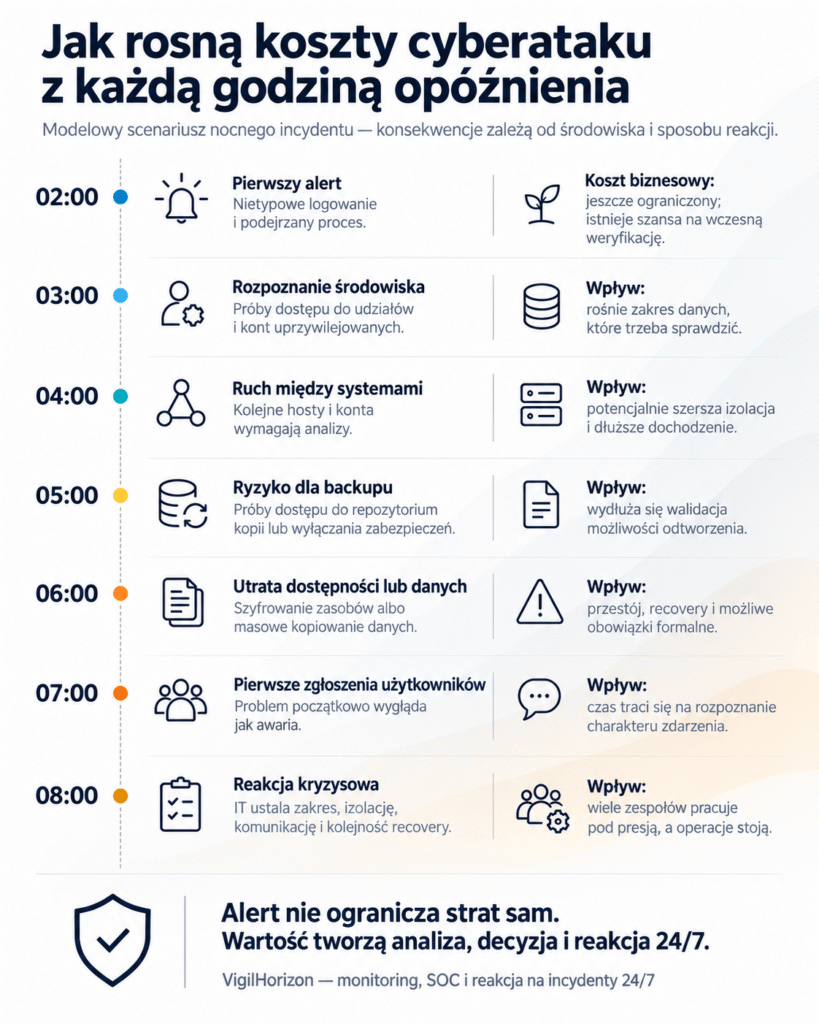
Six hours without a response: a 02:00–08:00 scenario
Consider an illustrative manufacturing and distribution company. It has workstation EDR, central logs, backups and administrators available on working days, but no round-the-clock security analysis or agreed overnight escalation path.
02:00. An unusual sign-in and suspicious process trigger an EDR alert. The notification is recorded, but nobody evaluates the context.
03:00. The attacker explores network shares and privileged accounts. Without correlation, nobody connects the sign-in, process and server access attempts.
04:00. The attacker moves between systems. Isolation is no longer limited to one device; further hosts and accounts need checking.
05:00. The attacker tries to access backups or disables controls. Even an intact backup will later require validation.
06:00. Resource encryption or bulk data copying begins. The first processes lose access to files and applications.
07:00. Employees report unavailable services. The helpdesk initially treats this as an outage, spending time identifying the nature of the event.
08:00. The full IT team determines scope, isolation, communications, evidence preservation and recovery order. The company has lost not just six hours, but the opportunity to contain the incident at its smallest scope.
This is an illustrative scenario, not a client case or a guaranteed sequence. It shows how each passing hour adds dependencies to investigate. With round-the-clock analysis, the first alert could have been correlated, classified and escalated; the outcome would still depend on permissions and the playbook.
What does one hour of company downtime cost?
There is no universal rate. An hour of booking system unavailability differs from an email outage, just as a production stoppage differs from an accounting interruption. Timing, seasonality, user numbers, manual work and the ability to catch up also matter.
A practical calculator can use five components:
Hourly downtime cost = lost margin or production value + employee idle time + workarounds and catch-up costs + penalties or SLA breaches + technical incident handling costs.
Use margin or value added rather than total revenue. Avoid counting labour costs twice if they are already included in production value. Assess complete downtime, reduced operation and catch-up work separately.
Illustrative calculation
For this example only, assume system unavailability means:
- 80 employees cannot perform 60% of their tasks, and their fully loaded hourly cost is PLN 85;
- the company loses PLN 12,000 in margin per hour from uncompleted operations;
- manual workarounds and later catch-up cost PLN 3,500 per hour of downtime;
- additional technical staff and advisers cost an average of PLN 4,000 per hour of active handling.
The hourly cost in this model is: 80 × PLN 85 × 60% + PLN 12,000 + PLN 3,500 + PLN 4,000 = PLN 23,580.
Eight hours of impact produces PLN 188,640 in this model. This is not a market average or a forecast for another company, but an illustration based on stated assumptions. Recovery, forensic analysis and communications may add further costs.
Compare monitoring investment against several scenarios: an incident on one host, four hours of restricted application access and a full day of disruption to a critical process. This range helps define acceptable risk.
Compare monitoring costs with an hour of downtime and the time an alert might remain unanalysed. If you do not know those figures, the uncertainty itself is an important finding.
How 24/7 security monitoring reduces costs
Monitoring changes incident economics when it shortens the path from signal to action. This requires appropriate data, detection rules, contextual analysis, classification, escalation and agreed actions.
| Area | Without round-the-clock alert handling | With effective 24/7 monitoring and response |
|---|---|---|
| Detection | an alert may wait for hours | the signal is analysed when it appears |
| Scope assessment | analysis begins after an outage is reported | events from multiple sources can be correlated earlier |
| Isolation | covers more resources when scope is uncertain | can start with a smaller, confirmed scope |
| Downtime | may last longer because of a late start and confusion | can be shorter through earlier decisions and playbooks |
| Recovery | more hosts, accounts and data require validation | a smaller scope may reduce restoration costs |
| Communication | the business learns after the effects appear | escalation can begin at defined thresholds |
| Evidence | some data may be overwritten or scattered | relevant logs and a timeline can be preserved sooner |
Monitoring alone does not guarantee shorter downtime. Without telemetry access, current contacts and authority to isolate an account, even rapid detection may not lead to action.
That is why SOC 24/7 should be assessed as an operational capability, not a tool name. VigilHorizon distinguishes basic alerting from a model in which events are analysed, classified and escalated under agreed rules. Response scope must follow the contract, architecture and responsibilities of both client and provider.
‘24/7’ also needs a definition: does only the infrastructure run continuously, or does a team analyse alerts? How quickly? Who receives escalations? Can the SOC isolate assets or only recommend action? Without answers, a company may buy continuous technology without continuous response.
The biggest cost is lost time: MTTD, MTTR and incident response
Two metrics express security in terms of time. MTTD is the average time to detect. MTTR may mean response, repair or recovery time, so the organisation must define the start and end points. These principles are discussed in MTTD and MTTR — why detection time determines incident impact.
Low MTTD without response provides knowledge but may not reduce losses. Even an effective team can do little if it learns of the incident only after processes stop. The entire chain is needed:
- a signal arrives from systems with monitoring coverage;
- the event is analysed in context;
- the incident receives a priority reflecting business impact;
- the appropriate people receive the escalation;
- a containment playbook is activated;
- services return in a controlled manner;
- lessons inform updates to detections, procedures and architecture.
NIST SP 800-61 Rev. 3 places preparation, detection, response and recovery within risk management (NIST, Incident Response Recommendations). Monitoring investment should therefore include technology and the readiness of people and processes.
Incident Response defines who classifies the event, approves isolation, preserves evidence and sets recovery priorities. Missing answers often increase MTTR more than the technical work itself.
A risk reduction model: people, processes and technology
A 24/7 monitoring capability starts with the systems and processes whose unavailability creates the greatest cost. Data, detections, coverage and response are selected afterwards.
1. Identify critical processes and downtime tolerance
Identify critical services and expected recovery times. A supporting system need not have the same coverage as identity, ERP, sales or production.
2. Establish visibility and data quality
The SOC needs identity, endpoint, network, cloud and critical system data, with appropriate timestamps, retention and context. SIEM without an analysis process can increase alert volumes without improving decisions.
3. Define escalation levels and permissions
A playbook should specify escalation levels, authority to block an account, isolate a host or stop a service, and the required acknowledgement time. VigilHorizon treats workable escalation as part of operational capability, not an optional addition to analysis.
4. Connect monitoring with backup, disaster recovery and continuity
Backups support recovery but do not replace detection. Their separation and integrity must be understood, along with a recovery sequence based on business priorities.
VigilHorizon handles incident detection, analysis and response, while SecureVault complements this with backup, disaster recovery and the capability to restore the environment safely after an incident.
5. Practise scenarios and measure timings
A tabletop exercise checks who answers the phone at 02:00, what they approve and how the decision is recorded. Measuring analysis, escalation, isolation and recovery gives MTTD and MTTR practical meaning.
6. Audit assumptions, not just configuration
An IT security audit should examine source coverage, alerts, roles, escalation, playbooks, retention and continuity. This distinguishes owning systems from being able to handle an incident.
Self-assessment: what could one hour of downtime cost your organisation?
An initial assessment can start with a workshop involving finance, IT and process owners. For each critical system, ask:
- What proportion of margin or production depends on the system?
- How many employees lose working capacity, and by what percentage?
- Can operations continue manually, for how long and at what cost?
- What SLA penalties or delay costs could arise?
- What does an hour of technical support cost?
- What is a realistic detection time overnight, at weekends and on holidays?
- Who has authority to isolate an account, host or service?
- Are backups tested and protected from access through the compromised environment?
- How far back do logs allow the incident timeline to be reconstructed?
- When are management, legal, the DPO and communications notified?
An hourly cost without undetected dwell time gives an incomplete picture. Alerting time without decision and isolation time confuses visibility with response. The assessment should produce a list of gaps, owners and deadlines.
VigilHorizon can begin by analysing the environment and alert handling, then tailor the scope of SOC 24/7 to the risk. The service level should reflect downtime costs, process criticality and response permissions.
Summary
There is no single price for the absence of 24/7 security monitoring. Its cost appears as extra attacker time, wider investigations, longer downtime and greater recovery uncertainty. Asking ‘What does a SOC cost?’ without valuing undetected dwell time and hourly downtime is incomplete.
Monitoring reduces risk when an alert leads to analysis, a decision and action. Appropriate data, round-the-clock coverage, playbooks, roles, backups and exercises do not eliminate attacks, but together can reduce their impact.
If you do not know who analyses out-of-hours alerts, how long escalation takes or what critical system downtime costs, start by documenting those three gaps. You can then compare an internal on-call model, hybrid support and an outsourced SOC. VigilHorizon helps carry out this security assessment and select monitoring and response coverage for the organisation’s actual risk, without assuming one model fits everyone.
Frequently asked questions (FAQ)
1. What does the absence of 24/7 security monitoring cost?
There is no universal rate. Cost depends on undetected dwell time, system criticality, incident scope, downtime and recovery. Calculate your own hourly downtime cost and compare it with a realistic out-of-hours detection time.
2. Does a lack of 24/7 monitoring mean a company will definitely suffer losses?
No. It does increase the risk that an overnight or weekend event develops longer without analysis and affects more resources.
3. Does SIEM alone provide 24/7 security monitoring?
SIEM collects and correlates data but does not independently provide round-the-clock operational capability. Analysis, prioritisation, escalation and an agreed response are still needed.
4. How does monitoring differ from a 24/7 SOC?
Monitoring may mean data collection and alerting. A 24/7 SOC includes analysis, classification, escalation and response support; its scope depends on the contract and responsibilities.
5. How do you calculate the cost of one hour of IT downtime?
Add lost margin or production value, employee idle time, manual workarounds and catch-up costs, penalties or SLA breaches, and technical support costs. Separate complete downtime from reduced operations and avoid double counting.
6. Does 24/7 monitoring prevent ransomware?
It does not guarantee prevention. It may detect signs earlier—unusual sign-ins, privilege escalation, bulk file access or disabled controls—and trigger containment before widespread encryption.
7. Why are backups not enough after a cyberattack?
Backups help recover data, but first the cause, incident scope, backup integrity and safe recovery point must be established. Restoring a system without removing the cause may recreate the conditions for another attack.
8. What do MTTD and MTTR mean?
MTTD is the average incident detection time. MTTR describes response, repair or recovery time, depending on the adopted definition. Both must use a consistent, documented measurement method for meaningful comparisons over time.
9. Does every company need a 24/7 SOC?
Every organisation should deliberately decide how to handle incidents outside office hours, but the model need not be identical. Options include an internal team, hybrid support or an external service. The decision should reflect process criticality, downtime cost and required response time.
10. How can you check whether current monitoring is effective?
Check critical system coverage, data quality, alert analysis time, false positives, escalation paths and isolation time. Then run an overnight scenario exercise to verify roles and contact details in practice.
11. Who should assess incident costs?
IT and security understand technical dependencies, but finance, process owners, management, legal or compliance, and continuity specialists are also needed. Together they can credibly assess business impact.
12. Where should a company start if it does not know its MTTD and MTTR?
Start with several critical scenarios and reconstruct timelines from logs, tickets and team actions. Define measurement start and end points, check overnight escalation, then set improvement targets and action owners.
Learn more
- MTTD and MTTR — why detection time determines incident impact
- What is SOC 24/7, and why is monitoring not enough?
- Incident Response: responding to a cyberattack step by step
- SIEM in your company — why deployment alone does not improve security
- IT security audits — what do they cover, and when are they useful?
Related articles



Not sure which plan is right for your business?
Complete a short questionnaire
Complete the form and we will help you select monitoring, incident handling or availability support for your organisation. We will agree the scope and service conditions before work begins.