
Lateral Movement — the attack stage most companies never notice
7 May 2026
A cyberattack rarely ends with the first compromised computer. We explain lateral movement and why this is often the stage at which organisations lose control of their entire network.
A company detects a problem on one workstation. The computer is disconnected, the administrator closes the ticket as a contained incident and normal work resumes. It looks like a fast, effective response. The problem is that, for an attacker, that computer is often only an entry point.
If the attacker has already stolen credentials, gained higher privileges or connected to other systems, the incident no longer concerns one device. It concerns the whole environment. This is where Lateral Movement begins—movement across the network that often remains invisible until data exfiltration, domain compromise or ransomware deployment.
Useful insights
- Lateral Movement is the stage of a cyberattack in which an attacker moves through an environment after gaining initial access.
- The first infected computer is rarely the ultimate target. It is more often an entry point for further reconnaissance of networks, accounts and critical systems.
- Ransomware is usually not the start of an attack. In many incidents, it is the culmination of earlier account compromise, privilege escalation and reconnaissance.
- Effective detection relies on event correlation, behavioral analysis and a response team and process matched to risk. A 24/7 SOC is one model for organizing this capability.
What is lateral movement?
Lateral Movement is the stage of a cyberattack in which an attacker starts moving through the IT environment after initial access. Rather than stopping at one computer, they seek additional accounts, systems, servers, network resources and data.
Operationally, lateral movement marks the point where an attack stops being a local problem on one device and becomes an organization-wide issue. The attacker may start on an employee workstation but usually targets other resources: file servers, backups or a domain controller.
This distinction matters for management, CTOs and CIOs. The first visible alert does not reveal the problem’s full scale. The key question is: where had the attacker reached before the company noticed the first symptom?

Why doesn’t the first alarm end the incident?
The first infected computer is often just where the organization noticed a symptom. It need not be where the attack began, nor the only system the attacker accessed.
Isolating one workstation is an appropriate technical action, but does not end analysis. Check whether the attacker moved on to other accounts, servers, critical systems or data.
This is where handling an individual alert differs from professional Incident Response. An alert is a signal, not an answer. Resilience depends on understanding the event’s context, classifying risk and initiating the right response.
In VigilHorizon’s approach, deploying a tool alone is not the starting point. Establish who watches the environment, analyzes alerts, escalates events and takes responsibility for decisions. Technology supplies signals; processes, people and accountability create response capability.
What does lateral movement look like, step by step?
Lateral movement rarely appears on a dashboard as one obvious „attack in progress” event. A typical scenario involves apparently technical activity: signing into another system, using an account with greater privileges, making a remote connection and accessing a network share.
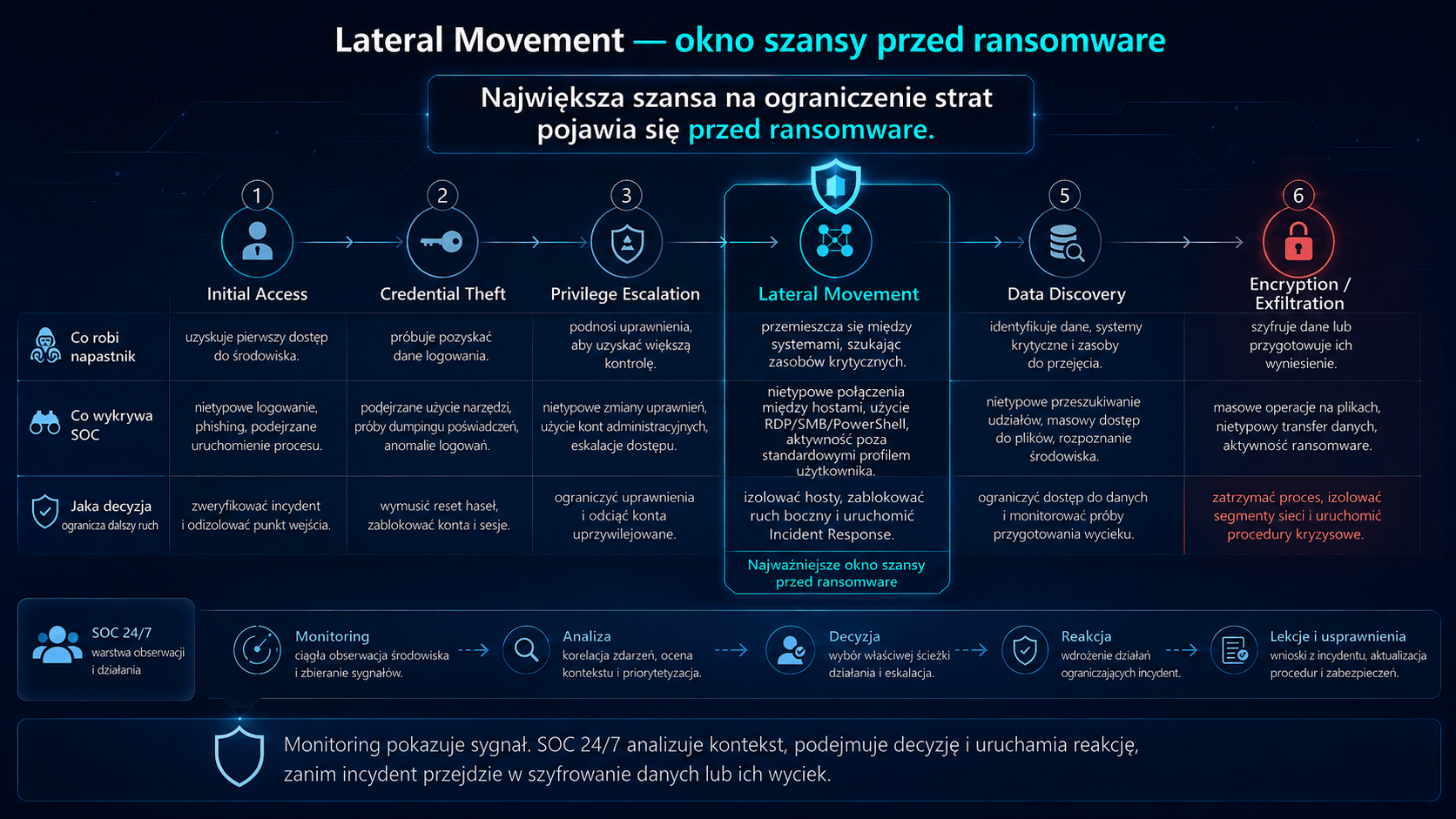
The sequence below is a reference model that organizes a typical attack path. In practice, stages may occur in a different order, overlap or be repeated in different parts of the environment.
1. Initial Access
The attacker enters through, for example, a compromised account, vulnerable service or infected workstation. For the organization, this is the start of analysis, not its end.
2. Credential Theft
Attackers seek accounts that let them continue without installing new tools on every system. Legitimate user, administrator or service accounts are especially valuable because they appear as normal sign-ins in logs.
3. Privilege Escalation
The attacker tries to expand their capabilities. If a privileged account is compromised, the incident quickly stops being a local workstation problem.
4. Lateral Movement
The attacker moves between systems. This is a crucial opportunity: the attack has not yet become downtime or encrypted data, but leaves signals the SOC should be able to connect.
5. Data Discovery
The attacker identifies the most valuable data, systems and assets: file shares, backups, production environments or sensitive information. The organization can still limit consequences before encryption or exfiltration.
6. Encryption / Exfiltration
The final stage is encryption, exfiltration or both. The company is then reacting to consequences: downtime, unavailable systems, confidentiality risks and operational pressure.
Lateral movement in MITRE ATT&CK
MITRE ATT&CK organizes adversary tactics and techniques. For security teams, it is useful as a shared language for describing behavior in IT environments, rather than a catalog of difficult names.
In this model, Lateral Movement (TA0008) means moving between systems. From a defensive perspective, techniques to consider include: Remote Services (T1021), Remote Desktop Protocol (T1021.001), SMB/Windows Admin Shares (T1021.002), Windows Management Instrumentation (T1047), Pass the Hash (T1550.002) and Pass the Ticket (T1550.003).
The aim is not to explain how to execute these techniques. What matters is that each leaves traces to assess in context: who is acting, from where, toward which resource, and whether the behavior fits normal work.
| Attack stage | What the attacker does | What the SOC should see | Business significance |
|---|---|---|---|
| Initial Access (TA0001) | Gains an initial foothold | An endpoint alert or unusual sign-in | The first symptom does not reveal the incident’s scale |
| Credential Access (TA0006) | Credential Access (TA0006) | Unusual account use and sign-ins from new hosts | A legitimate account conceals attacker activity |
| Privilege Escalation (TA0004) | Gains greater privileges | Administrative account use outside normal context | Risk to critical systems increases |
| Lateral Movement (TA0008) | Moves between systems | RDP, SMB, WMI, PsExec and access to multiple hosts | This is the main opportunity before ransomware |
| Impact (TA0040) / Exfiltration (TA0010) | Encrypts or exfiltrates data | Mass file operations and unusual data transfers | The organization faces downtime, data loss and communication pressure |
How does a SOC detect lateral movement?
Lateral movement rarely looks like one obvious alarm. Events that seem technically explainable individually can form a worrying pattern together: unusual sign-ins, privileged-account use, remote administration, SMB traffic, PowerShell activity and access attempts across many systems.
A SOC detects lateral movement by connecting signals from SIEM, EDR/XDR, identity systems, VPNs, firewalls, servers and administrative logs. One event may be harmless, but several involving the same account or host change the risk assessment.
SOC 24/7 has a different role from conventional monitoring. It receives, analyzes, classifies and escalates signals, then initiates response when events begin to form an incident picture. This matters especially outside IT working hours, when response delays let an attack spread.
VigilHorizon’s approach treats the SOC as more than an „alert team.” It is an operating model in which analysts, escalation procedures, playbooks and decision owners work together. The organization moves beyond „something happened” to ask what it means, who decides and how to limit consequences.
Effective defense is not only about detecting ransomware. In many cases, that is the final and most visible attack stage. The priority is recognizing earlier lateral-movement signals—unusual sign-ins, privileged-account use and cross-system connections—before the attacker gains real control.
What happens if lateral movement is not stopped?
Undetected lateral movement gives the attacker time to expand the incident: more compromised accounts, more explored servers, more affected assets and a harder-to-reconstruct attack sequence.
For management, the consequences are downtime, data loss, recovery costs, communication pressure and reputational risk. For CTOs, CIOs and IT, it means working under pressure, often unsure which systems remain trustworthy.
Ransomware is often the culmination of earlier actions. Before encryption, the attacker explores the environment, steals credentials, escalates privileges, checks backups and chooses when to strike. Detecting ransomware means responding to the outcome; detecting lateral movement offers an earlier chance to limit losses.
Give your business 24/7 cyber protection
If an organization detects only encryption, it responds to the incident’s final stage. The real opportunity to limit losses comes earlier, during lateral movement, when the attacker is moving through the environment but has not yet caused widespread paralysis.
Check whether your current security monitoring detects unusual account use, remote administrative connections, privilege escalation and access to multiple systems. The next step is a threat detection capability assessment or a consultation on SOC 24/7.
A risk reduction model
No single tool can eliminate lateral-movement risk. The goal is to make movement harder, detect unusual behavior sooner and limit the incident’s scope.
An effective model collects signals from SIEM, EDR/XDR, identity and networks; correlates events; detects unusual behavior; classifies the incident; escalates to SOC/incident response; isolates assets or restricts access; preserves evidence; verifies scope; and improves detection rules.
VigilHorizon creates value here through structured operations as well as technology. Tools matter, but combining monitoring, analysis, escalation, accountability and response moves an organization from „we see an alert” to „we know what to do and who decides.”
Readiness checklist
| Check question | Answer |
|---|---|
| Does security monitoring operate 24/7? | YES / NO |
| Are AD, EDR/XDR and SIEM logs correlated? | YES / NO |
| Does the organization detect unusual privileged-account use? | YES / NO |
| Are remote administrative connections such as RDP, WMI and SMB monitored? | YES / NO |
| Is there a playbook for compromised accounts and lateral movement? | YES / NO |
| Is it clear who decides on account blocking or system isolation? | YES / NO |
| Are MTTD and MTTR measured for lateral-movement scenarios? | YES / NO |
| Does network segmentation restrict free movement between systems? | YES / NO |
| Are backup, disaster recovery and business continuity connected to incident response? | YES / NO |
If most answers are „no,” the organization probably sees individual events but lacks full capability to detect and stop lateral movement before ransomware.
Case study: from one workstation to the risk of domain compromise
A medium-sized organization detects an alert on an administration employee’s workstation. The endpoint is isolated and IT begins standard remediation. At first glance, the incident appears limited to one computer.
Before isolation, however, the attacker had already used stolen credentials. The user account connected to several servers, followed by activity involving an account with broader privileges.
Without log correlation, events look separate: an endpoint alert, an unusual sign-in, network-share access and administrative activity outside normal context. SOC analysis links them into one scenario: possible lateral movement after initial access.
This scenario shows why isolating one workstation does not conclude incident handling. The priority is determining whether the attack reached other accounts, servers, critical systems or data.
Summary
The best opportunity to stop a cyberattack comes before server encryption, while the attacker is moving through the environment and preparing further actions.
Detecting lateral movement requires event correlation, continuous behavioral analysis and a team able to distinguish normal administration from attacker activity. Modern SOC teams therefore focus on detecting attacks before users see their effects.
VigilHorizon supports organizations in assessing threat detection capability, reviewing monitoring, implementing SOC 24/7 and preparing procedures for Incident Response. The goal is to build the ability to detect quickly, decide and limit incident consequences.
Frequently asked questions (FAQ)
What is lateral movement?
Lateral movement is the stage of a cyberattack in which an attacker moves through the IT environment after gaining initial access, aiming to reach further systems, accounts, data and critical assets.
Why is lateral movement dangerous?
It expands an incident from one device to further accounts, servers, data and critical systems. The longer the attacker moves through the environment, the harder it becomes to limit damage.
Does ransomware begin with encryption?
In many cases, no. Encryption is the final stage. Earlier, the attacker obtains credentials, escalates privileges, explores the environment, checks backups and prepares the attack.
How does a SOC detect lateral movement?
A SOC detects lateral movement by correlating signals from SIEM, EDR/XDR, Active Directory logs, VPNs, servers, firewalls and critical systems. Analysts assess whether unusual sign-ins, privileged-account use or cross-system connections form an incident scenario.
Does EDR detect lateral movement?
EDR can detect some associated behavior, such as unusual process execution, remote commands or suspicious endpoint activity. It does not provide a complete view of the environment, so effective detection also requires correlation with SIEM, identity systems, network logs and server infrastructure.
Does network segmentation limit lateral movement?
Yes. Segmentation can restrict an attacker’s movement between systems and reduce incident scope. It does not replace monitoring or incident response: unusual activity must still be detected, assessed and addressed.
Does lateral movement always follow the same sequence?
No. Treat the stages shown as a reference model for understanding a typical attack. In practice, an attacker may act in a different order, return to earlier stages or conduct several activities in parallel. Effective detection should correlate behavior and events across the environment rather than expect one fixed pattern.
Learn more
Related articles



Not sure which plan is right for your business?
Complete a short questionnaire
Complete the form and we will help you select monitoring, incident handling or availability support for your organisation. We will agree the scope and service conditions before work begins.