
A day in the life of a SOC analyst: inside 24/7 security monitoring
23 May 2026

What does a routine SOC analyst shift look like? We follow the path from the first alert through analysis and escalation to incident response in a security operations centre.
It is 07:00. An analyst takes over from the night team. At first glance, everything looks calm, but in a security operations centre calm does not mean there is no work. Open cases need checking, environmental changes need reviewing, and the team must ensure no important signal has disappeared among routine alerts.
At 08:10, an alert turns out to be harmless after analysis. At 09:42, another signal looks equally unremarkable. This time, however, several events begin to form a story suggesting possible credential theft.
This is what 24/7 security monitoring looks like in practice: not passively watching screens, but a sequence of decisions based on data, context and agreed procedures.
What should you know?
- An alert starts an investigation; it does not confirm an attack. The analyst must check the user, device, time and related events.
- Much of SOC work involves distinguishing normal activity from threats. Properly closing a false positive is an evidence-based decision, not an automatic click.
- A single signal may carry little significance. Only correlation across SIEM, EDR, identity, network and cloud data reveals the sequence of actions.
- The SOC does not sit idle waiting for a major incident. Between alerts, analysts tune rules, update playbooks, analyse trends and check telemetry quality.
- 24/7 continuity depends on people and process. Shift handovers, current contacts, authority and the customer’s readiness to cooperate matter as much as functioning tools.
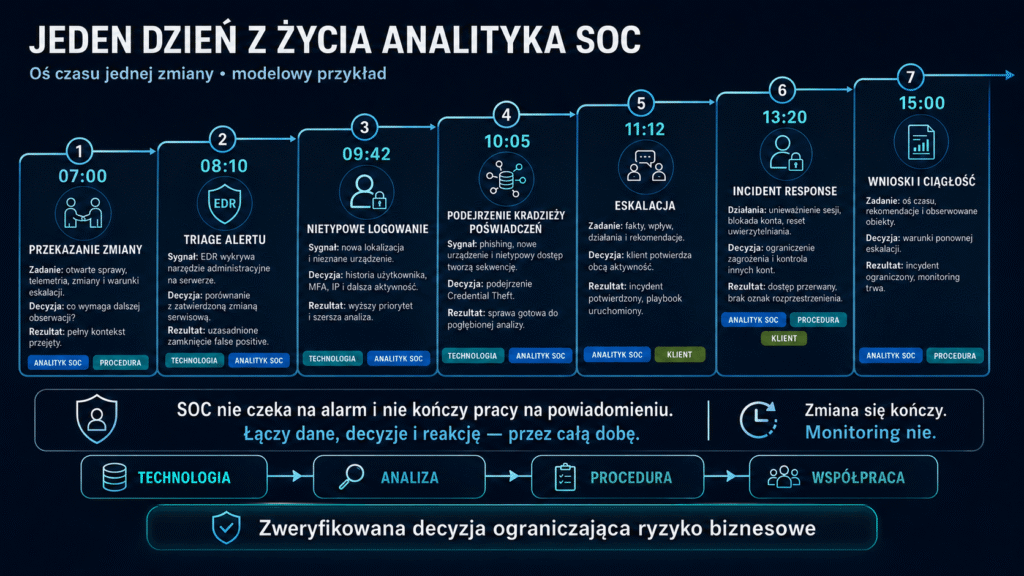
07:00 — the shift begins with context
The night analyst does not finish with a simple 'no incidents’. The team reviews open cases, observed behaviour, planned administrative work and sources that have stopped reporting. A configuration change may explain some alerts, but can also make attacker activity harder to notice.
The incoming analyst focuses on:
- open cases, completed actions and hypotheses not yet verified;
- entities requiring continued observation;
- customer contacts who have been informed;
- conditions for further escalation;
- the health of key telemetry sources.
A SOC needs continuous data, not merely some data. Missing domain controller logs or an EDR communication gap do not indicate a quiet environment. They indicate a visibility gap that needs classification and resolution.
What a shift handover must include
| Area | What to hand over | Why it matters |
|---|---|---|
| Open alerts and incidents | Status, priority, timeline, completed actions and the next step | Prevents interrupted analysis and duplicated work |
| Accounts and hosts under observation | Reasons for monitoring, observed behaviour and escalation conditions | Helps identify the next element in a sequence |
| Changes at the customer | Maintenance, deployments, service accounts and unusual activity | Reduces false positives without ignoring real risk |
| Telemetry health | Missing logs, delays and integration failures | Shows where SOC visibility is limited |
| Communication | People informed, pending decisions and deadlines | Provides clear ownership and continuous escalation |
At VigilHorizon, an alert does not belong to one analyst. It is a team-managed case with its history, decisions and ownership preserved.
08:10 — the first alert proves to be a false positive
EDR reports an administrative tool running on a server. The rule has high priority because similar tools are used for remote command execution. The alert alone does not answer the key question: was the action unauthorised?
The analyst checks the host, account, parent process, timing and history of similar events. Approved maintenance is found in the ticketing system. The account belongs to an administrator and the commands match the planned update.
At 08:19, the alert is closed as a false positive, with a documented rationale and a reference to the maintenance change.
The analyst:
- confirmed a legitimate explanation for the activity;
- checked related anomalies;
- recorded the rationale and information for rule tuning.
What triage involves
Triage is an initial alert assessment. The analyst establishes what the tool detected, which user and asset are involved, whether the data is reliable, whether a legitimate explanation exists and what the impact may be. The outcome is dismissal, further analysis, reprioritisation or immediate escalation.
Deploying a tool does not perform these steps. SIEM without the right data, rules and analysis process does not automatically improve security. The platform organises signals, but the team remains responsible for interpretation.
Expert comment: A SOC analyst’s value is not measured by how many alerts they close quickly. It lies in distinguishing normal activity from threats, justifying decisions and recognising when a single signal becomes part of a larger story.
09:42 — an unusual login calls for a wider view
An alert about a cloud login from an unusual location enters the queue. Travel, a VPN or a mobile operator might explain it. Automatic blocking could interrupt work, while ignoring it could leave a compromised account unaddressed.
The analyst checks:
- login and device history;
- the authentication method and MFA outcome;
- the IP address and source reputation;
- activity before and after the login;
- the user’s role and access to resources.
There is not yet enough evidence to confirm an incident. However, the session comes from a new browser, and shortly afterwards the account accesses a repository the employee rarely uses.
The analyst raises the case priority and begins correlating EDR, email, identity and application log data. This is where security monitoring moves beyond watching a single dashboard. It requires connecting events that might individually fall below the response threshold.
VigilHorizon treats an alert as a hypothesis requiring organisational context. Its significance depends on the account’s role, asset criticality, user behaviour and sequence of actions, not solely on the tool’s score.
10:05 — a single alert becomes suspected credential theft
Correlation reveals more pieces. Several dozen minutes earlier, the user received a message resembling a shared-document notification. EDR found no malicious file, because the attack may have led to a fake login page. The identity system records successful authentication from a new device, followed by unusual resource browsing.
None of these signals alone proves an attack:
- the message might have been legitimate;
- the new device might have belonged to the user;
- document access might have been part of a new assignment;
- the unusual location might have resulted from a VPN.
Together, they support a coherent credential-theft hypothesis. The analyst no longer describes the case as an unusual login, but as suspected account compromise with possible data access.
The priority also changes. Although the account lacks administrative privileges, it can access project documents and shared resources. The potential impact extends beyond one user to information accessible through that account.
From signal to decision
A decision must be traceable. Another analyst needs to understand:
- confirmed facts and unverified hypotheses;
- why the classification changed;
- the potential impact and missing information;
- which action is proportionate to the risk.
This distinction protects against two mistakes: overreacting to an unconfirmed signal and waiting too long for absolute certainty.
11:12 — escalation communicates findings, not a raw alert
The case moves to deeper analysis and the designated customer contact. Escalation is more than forwarding a screenshot with a red warning.
The communication includes:
- the time, account and resources under investigation;
- confirmed events and an assessment of the hypothesis;
- potential impact and actions already taken;
- recommended steps and the decision required from the customer.
The customer confirms that the user is not travelling, has not used a new device and has not opened the repository. The account-compromise hypothesis gains strong support.
Immediate actions depend on the agreed operating model. In one environment, the SOC may revoke sessions and temporarily block an account independently. In another, system-owner approval is required. This is not a minor procedural detail. Unclear authority can turn rapid detection into a long wait for a decision.
That is why VigilHorizon SOC 24/7 includes not only event analysis but also agreed escalation paths, playbooks and responsibilities. Before an incident, the organisation should know who can block an account, isolate a device and accept downtime risk.
13:20 — Incident Response turns analysis into action
After account compromise is confirmed, sessions are revoked, the account is blocked, and the password and authentication methods are reset. The team also checks whether the attacker added an MFA method, mail rules or application permissions.
Incident scoping continues in parallel:
- files opened or downloaded;
- attempts to access other systems;
- similar logins on further accounts;
- phishing traces on the device;
- the same indicators elsewhere in the environment.
Changing a password alone is insufficient if sessions remain valid or the attacker has added another authentication method.
The SOC coordinates technical analysis while working with the administrator, system owner and business decision-makers. Depending on findings, legal, data protection or communications teams may also join. The complete Incident Response process includes not only identification, but containment, root-cause remediation, recovery and lessons learned.
At 14:05, there are no signs that the account was used for lateral movement or persistence. Analysis nevertheless shows that the attacker opened several documents. This remains an incident even without ransomware or system disruption. Further handling depends on the data, impact assessment and customer procedures.
What happens in the SOC between major incidents
An incident narrative can suggest that SOC work consists solely of critical situations. In reality, maturity is also built during quieter hours.
Analysts revisit closed cases and look for patterns: recurring false positives, noisy rules and missing data. They also verify implementation of earlier recommendations.
The table shows typical tasks during a shift:
| Time or area | Analyst task | Decision or outcome |
|---|---|---|
| Start of shift | Review open cases, source health and environmental changes | Maintain continuity of analysis |
| Current queue | Triage, data enrichment and alert prioritisation | Dismissal, observation, deeper analysis or escalation |
| Event analysis | Correlate SIEM, EDR, identity, network, email and cloud data | Confirm or reject a hypothesis |
| Threat Intelligence | Check indicators, techniques and campaign context | Better assessment of threat credibility and scope |
| Detection tuning | Analyse false positives and false negatives; adjust rule logic | Less noise without losing important signals |
| Threat Hunting | Search for behaviour not flagged by an existing rule | Discover gaps and new use cases |
| Playbooks and documentation | Update steps, contacts and escalation conditions | Faster, more predictable response |
| End of shift | Report, record decisions and hand over open cases | The next analyst receives the full context |
The SOC does not wait for another attack to improve. If analysis took too long, the team determines whether data, access, procedures or expertise were missing. Threat intelligence prompts a further question: are the attacker’s techniques visible in telemetry and covered by detection?
SOC analysts and IT administrators — different roles, a shared goal
IT administrators maintain services, implement changes and resolve technical problems. SOC analysts focus on behaviour indicating threats, event reconstruction and incident handling.
The roles complement each other. Administrators explain change context and act in systems, while the SOC provides assessment, scope and recommendations.
| Area | IT administrator | SOC analyst | Collaboration point |
|---|---|---|---|
| Primary objective | Availability, configuration and environment maintenance | Threat detection, analysis and containment | Keeping the business operating securely |
| Perspective | System health and correct operation | User, device and attacker behaviour | Assessing whether an anomaly is a change, a fault or an attack |
| Security alerts | May receive them alongside many other responsibilities | Continuously performs triage and correlation | Verifying technical context |
| Response | Changes systems and restores services | Recommends or initiates containment within its authority | Isolation, account blocking, resets and safe recovery |
| Working hours | Usually follows the organisation’s staffing and on-call arrangements | Under SOC 24/7, analysis continues around the clock | Out-of-hours escalation |
| Documentation | Documents configurations, changes and failures | Documents facts, hypotheses, timelines and incident decisions | A shared record of events and causes |
| Improvement | Improves environmental stability and architecture | Detection tuning, hunting and playbook development | Implementing post-incident recommendations |
The SOC does not replace administrators. An on-call administrator does not automatically become a SOC either. The difference lies in continuous focus on detection, access to correlated telemetry, analytical methodology and readiness to manage incidents.
15:00 — incident closure does not end monitoring
By the end of the shift, the account is secured, active sessions revoked and suspicious activity stopped. No signs of the attack spreading to other accounts have been found. Immediate containment can be closed, but not all post-incident work.
The analyst completes the timeline and separates facts from conclusions, documenting:
- the first signal, classification changes and investigation scope;
- actions, outcomes and customer decisions;
- unresolved questions and recommendations.
Recommendations may address access conditions, phishing-resistant MFA, unnecessary privileges and correlation rules. They should follow the findings, not a universal checklist.
At 15:00, the next handover begins. The incoming analyst receives the incident status, entities still under observation and re-escalation conditions. If another account shows a similar pattern, it will not be treated as an isolated alert.
This is how VigilHorizon understands monitoring continuity: the people on duty change, but the case context remains. Documentation and process preserve shared responsibility.

Why security monitoring must operate 24/7
An attack does not stop at 17:00. A compromised account, malicious process or active session can be used overnight, at weekends and on holidays. If an alert waits until morning, the attacker gains time to explore the environment, expand access, steal data or prepare the next stage.
24/7 operation requires more than a platform receiving logs. It needs:
- analysts and continuous access to data;
- priorities, playbooks and escalation channels;
- agreed response authority;
- a customer contact;
- shift handovers that preserve context.
This continuity affects MTTD and MTTR: the time needed to detect and respond. Metrics need careful definitions, because MTTR may refer to response, repair, remediation or recovery. Whatever the definition, quickly generating an alert does not reduce risk if analysis and action are missing afterwards. These metrics are discussed further in MTTD and MTTR — why detection time determines incident impact.
The consequences of delay are also illustrated by the scenario of an alert raised overnight but noticed only in the morning.
SOC 24/7 is not another dashboard tool. It is an organisational capability: technology provides visibility, analysts make decisions, procedures structure response, and the customer supplies context and the ability to act.
Summary
A SOC analyst’s shift involves far more than handling visible alerts. It begins with taking over context, continues through signal verification, correlation and escalation decisions, and ends with documentation, lessons and a handover of responsibility.
A false positive is not a system failure if it is explained promptly and reliably. An unusual login is not yet an incident, but may be its first visible sign. SOC effectiveness lies in recognising the difference and responding when the facts justify action.
VigilHorizon combines IT security monitoring, event analysis, SIEM/XDR correlation, playbooks and cooperation with the customer’s team. The aim is not more notifications, but a shorter path from a signal to a risk-reducing decision.
If it is unclear who analyses an alert at 02:00, who can block an account or how a case passes to the next shift, review the operating model before an incident. Talk to VigilHorizon experts about monitoring and SOC 24/7 tailored to your environment and your team’s responsibilities.
Frequently asked questions (FAQ)
What is a SOC analyst?
A SOC analyst analyses events, correlates data, assesses risk, classifies incidents and coordinates response, combining technical knowledge with organisational context.
Does a SOC analyst watch a dashboard all day?
No. A dashboard is one source. Analysts also work with logs, EDR, SIEM, identity systems, network data, tickets and customer communications.
Does every alert indicate a cyberattack?
No. An alert may describe legitimate activity, an error, a false positive or a threat. Triage and analysis establish the classification.
What does SOC alert analysis involve?
The analyst checks the source, user, device, time, history, asset criticality and related events, then closes, observes, investigates or escalates the alert.
What does a SOC analyst do between incidents?
Tune rules, analyse false positives, check telemetry, update playbooks, conduct threat hunting and verify recommendations.
What happens during a SOC shift handover?
The team hands over open cases, facts, hypotheses, completed actions, entities under observation and escalation conditions.
Does a SOC operate around the clock?
SOC 24/7 provides analysis and response readiness overnight, at weekends and on holidays. It requires tools, analysts, procedures, permissions and contacts.
Does a SOC replace an IT administrator?
No. Administrators maintain the environment, while the SOC focuses on detection and threats. During incidents, the SOC supplies assessments and administrators supply system knowledge and operational actions.
How does SIEM differ from a SOC?
SIEM collects and correlates events. A SOC encompasses people, processes, technology and responsibility. SIEM supports the SOC but does not manage incidents on its own.
Must a company build its own SOC?
No. Internal, managed-service and hybrid models are available. The choice depends on risk, scale, expertise and response scope, but ownership of 24/7 analysis must remain clear.
Learn more:
- What is SOC 24/7? How a Security Operations Center works and why monitoring is not enough
- MTTD and MTTR — why detection time determines incident impact
- Incident Response: responding to a cyberattack step by step
- SIEM in your company — why deployment alone does not improve security
- The alert appeared at 2:13 a.m. The administrator saw it at 8:04 a.m.
Related articles



Not sure which plan is right for your business?
Complete a short questionnaire
Complete the form and we will help you select monitoring, incident handling or availability support for your organisation. We will agree the scope and service conditions before work begins.