
Why did SIEM fail to detect ransomware? Common causes and organisational mistakes
Events
15 June 2026

A SIEM system can analyse millions of events and still fail to stop ransomware. We explain why technology alone is not enough and which mistakes most often delay attack detection.
The SIEM collected logs and its dashboard was green. Yet ransomware encrypted servers and stopped operations. Did the technology fail? Not necessarily. More often, the chain between the first signal and the response breaks down.
Key points:
- SIEM cannot see what the organisation does not send in logs and telemetry.
- Recording an event, creating an alert, confirming an incident and stopping an attack are four different stages.
- Correlation rules need environmental tuning, updates and regular testing; default configurations quickly lose value.
- An alert without an owner, context or an escalation procedure stays in the queue while the attacker moves through the environment.
- SIEM delivers its full value as part of a process incorporating a 24/7 SOC, EDR/XDR and prepared incident response.
- The real test is not the number of logs collected, but the time from the first signal to an appropriate decision and action.
How SIEM works during a cyberattack
SIEM—Security Information and Event Management—centralises security data and links events that might appear harmless individually. During ransomware attacks, its role begins well before file encryption.
A typical chain includes:
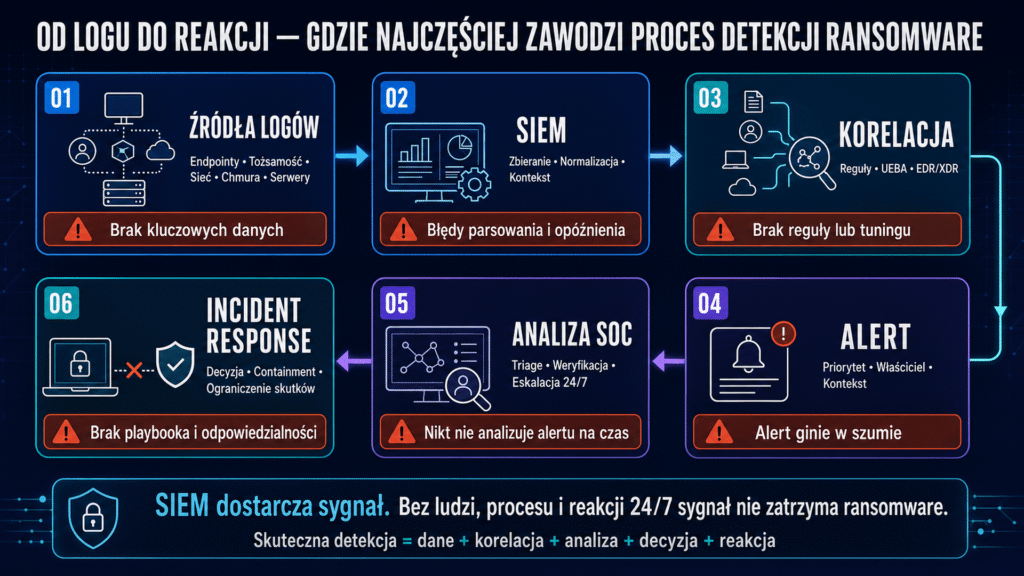
Log sources → transport and parsing → normalisation → correlation → alert → SOC analysis → incident response
Each link depends on the previous one. Missing telemetry, incorrectly mapped fields or inaccurate timestamps prevent correlation. Alerts without asset criticality information make prioritisation harder.
Data collection and normalisation
Sources include identity systems, EDR/XDR, servers, networks, email, VPN, cloud and backups. ‘Source connected’ does not confirm quality: completeness, delays, timestamps and parsing must be checked. Normalisation converts different data into a common model so a rule can connect a VPN sign-in, a permission change and process activity.
Correlation and alert generation
A rule looks for a high-severity event or a sequence of weaker signals, such as an unusual sign-in, privileged account use and disabled controls. It needs asset, user and baseline context. An overly broad rule creates noise; an overly narrow one misses attack variants. UEBA and EDR/XDR data extend analysis but also require tuning and validation.
Analysis and response
An alert is a hypothesis to investigate. The analyst enriches the data, assesses scope and priority, then either closes the alert or classifies an incident and activates a playbook: endpoint isolation, account blocking, communication restrictions and escalation.
This is where technology becomes operational accountability. In VigilHorizon’s model, detection does not end with a notification. SIEM and XDR support a process that defines who analyses the signal, who decides and how response begins without waiting for the next working day.
The most common reasons SIEM is ineffective
An ineffective SIEM rarely has just one cause. Incomplete telemetry typically limits visibility, weak correlation fails to generate an alert and an overloaded queue delays analysis.
| Cause | What happens during the attack | How to verify it |
|---|---|---|
| Missing logs from critical systems | Attack stages remain invisible or cannot be connected | Compare the asset inventory with active sources and event types |
| Parsing and normalisation errors | Rules reference empty or incorrect fields | Check data quality, timestamps and schema consistency |
| Incomplete detection coverage | SIEM stores the evidence but no rule looks for the sequence | Map attack scenarios to data sources and rules |
| Rules poorly matched to the environment | Too many false positives, or excessively high thresholds | Tune rules using triage findings and infrastructure changes |
| Missing updates | New techniques, systems or integrations lack detection coverage | Maintain a review cycle for rules, parsers and exceptions |
| Missing asset and identity context | Critical system alerts do not receive the right priority | Enrich events with ownership, role, criticality and exposure |
| Too many alerts | An important signal is lost among similarly prioritised alerts | Measure volume, time to start analysis and the proportion of closed alerts |
| No 24/7 analysis | An overnight alert waits until morning while the attacker continues | Check actual staffing, on-call coverage, SLAs and escalation |
| Missing playbooks and permissions | A confirmed incident does not lead to prompt isolation | Test decisions, contacts and technical actions during exercises |
Logs are collected, but not the ones needed
Log volume is not a measure of coverage. Sources must reveal specific scenarios: account misuse, code execution, privilege escalation, lateral movement and preparation for encryption. When a company adds cloud services, an identity system or a network segment, its telemetry must deliberately be brought into monitoring.
Rules exist, but coverage is inconsistent
Prebuilt rules are a starting point. Every environment has different service accounts, administration tools and critical assets. Tuning should not mean merely silencing alerts. Each exception needs a rationale, owner and review date; otherwise the SIEM becomes quieter rather than more effective.
Alerts have no owner
The costliest gap may be organisational: an administrator checks the console between other tasks, while overnight alerts go only to an inbox. This is the difference between basic IT security monitoring and a SOC 24/7, which includes prioritisation, validation, escalation and agreed actions. Without this, the company has evidence of the attack but cannot use it in time.
Expert comment: ‘After an incident, we often find that the necessary information was already in the logs. The problem was that nobody connected it into a coherent story or owned the decision. SIEM provides signals; a prepared team and process turn them into a response.’
Scenario: the alert existed, but response came too late
The following is an illustrative scenario based on common dependencies encountered during incident handling.
An employee opens a malicious attachment. EDR records an unusual process as a medium-priority alert. Later, the same account authenticates to several systems and an administration tool runs on a server. Logs reach the SIEM but no shared correlation rule connects them.
The platform generates separate alerts, none exceeding the critical threshold. The first enters the queue after the IT team has finished work. Further signals appear overnight: privileged account use, disabled protection and increased file activity.
By morning, some servers are unavailable. Only widespread encryption triggers a high-priority rule. The SIEM ‘detects ransomware’, but only after the attack affects business operations.
The platform collected data and created alerts. Correlation, prioritisation and 24/7 analysis failed. Operational monitoring could have connected the EDR alert with sign-ins and server activity, triggering the playbook earlier. This does not guarantee stopping every attack, but shortens the path from signal to action.
What happens after an alert is generated
An alert does not complete the process. It transfers responsibility from detection to security operations:
Alert → SOC triage → analysis and enrichment → incident confirmation → containment → further incident response
Triage and validation
The analyst assesses the alert, user and host activity, system criticality and related EDR/XDR and network data, determining whether this is legitimate variation, a false positive or an active incident.
Confirmation and escalation
Confirmation requires an escalation path: who blocks the account, who approves server isolation and how to reach the process owner overnight. At VigilHorizon, analysis and escalation ownership are part of the service model. Technology provides context, the team assesses risk and the playbook defines permitted actions.
Incident Response
Containment includes device isolation, account blocking or communication restrictions, taking business impact into account. The team then removes the cause, restores operations and documents the incident. We explain the full process in Incident Response — responding to a cyberattack step by step. Automation accelerates selected steps but requires safe conditions, permissions and exception handling.

SIEM alone versus SIEM supported by a SOC
The difference is whether the data is supported by a process with clearly assigned accountability.
| Area | SIEM alone | SIEM + SOC |
|---|---|---|
| Data collection | Centralises configured logs | Also monitors source quality, completeness and delays |
| Correlation | Runs configured rules and analytics | Develops use cases, tunes rules and applies analysis findings |
| Alert | Creates an event for investigation | Assigns priority, ownership and business context |
| Analysis | Depends on the organisation’s staff availability | Delivered under a defined operating model, including 24/7 coverage |
| Incident confirmation | Does not follow automatically from an alert | An analyst verifies signals and classifies the incident |
| Decision | Requires accountability outside the tool | Has a defined escalation path and roles |
| Response | Possible only through preconfigured integrations or a separate team | Initiated using playbooks and agreed permissions |
| Improvement | Rules may remain unchanged | Findings from alerts, tests and incidents feed back into detection |
SIEM can be a sufficient architectural component where an organisation already has a mature team, on-call coverage and incident response processes. The problem begins when buying a platform is expected to replace those capabilities. A SOC is a way of working that combines people, procedures and technology, not a module that automatically fixes every configuration.
Check whether your SIEM takes you from signal to decision
If critical sources, overnight alert ownership and time from detection to containment are unclear, consider a security assessment. Its purpose should be to identify gaps in visibility, rules, staffing and response ownership, not produce another report on log volumes.
How to improve SIEM effectiveness
Improvement starts with priority scenarios, required data and the expected response—not hundreds of new rules.
1. Connect log sources to risk
Prioritise identity systems, endpoints, critical assets, remote access, cloud and backups. Each source needs an owner, expected event types and checks for completeness and delays.
2. Build detections around attack scenarios
A use case should connect business risk, observable behaviour, data, rule logic, validation and expected action. A list of active rules alone does not show which scenarios the organisation can recognise.
3. Tune rather than silence
Tuning covers thresholds, time windows, exceptions and asset criticality. It should reduce noise without removing visibility. Review rules after infrastructure changes, tests and incidents.
4. Combine SIEM with EDR/XDR and organisational context
EDR provides endpoint telemetry and response, XDR correlates signals across layers, and SIEM combines them with a broader set of logs. UEBA helps detect behavioural deviations. All need quality data, tuning and analysis and should form one detection and response system. Their roles and limitations are compared in EDR, XDR and MDR — how they differ and when they protect your business.
5. Provide round-the-clock analysis
24/7 monitoring matters when it includes analysis, not merely notifications. It requires staffing, alert pickup times, escalation levels, contact channels and the on-duty analyst’s decision authority. The distinction is explained in What a 24/7 SOC is and why monitoring alone is not enough.
6. Prepare playbooks and permissions
A playbook sets out technical steps, decision owners, escalation criteria and documentation. Agree when a host may be isolated or an account blocked. VigilHorizon links alert analysis to this response model so accountability is as clear as platform configuration.
7. Test the entire chain and measure timings
Testing should verify log delivery, rule operation, alert priority, analysis start, escalation and playbook execution—not just an entry in a console.
Useful metrics include:
- MTTD (Mean Time to Detect) —the average time from the start or occurrence of the measured event to detection;
- alert pickup time —time from alert creation to the start of analysis;
- confirmation time —time needed to classify the event as an incident;
- MTTR —in this article, the average response time from detection to the start of agreed containment actions.
MTTR must always be defined, since it may also mean repair or recovery time. Consistent measurement and identifying where delays occur are what matter.
We discuss interpretation of both metrics and their impact on incident scope in MTTD and MTTR — why detection time determines incident impact.
How to recognise a SIEM that only appears to work
This checklist does not assess the licence itself. It checks whether the organisation has complete detection and response capability. Select one answer for each question.
| Question | Answer |
|---|---|
| Do all critical systems and services send the required logs? | YES / NO |
| Are data quality, completeness and timeliness monitored? | YES / NO |
| Is there a map of attack scenarios, data sources and detection rules? | YES / NO |
| Are rules updated after environmental changes and incident findings? | YES / NO |
| Do exceptions and suppressed alerts have owners and review dates? | YES / NO |
| Are alerts analysed around the clock, including weekends and holidays? | YES / NO |
| Does every high-risk alert have an owner and escalation path? | YES / NO |
| Does the analyst understand asset criticality and business context? | YES / NO |
| Do playbooks define who may isolate a system or block an account? | YES / NO |
| Does the organisation regularly test the chain from signal generation to response? | YES / NO |
| Are MTTD, alert pickup time and MTTR measured and reviewed? | YES / NO |
| Do incident and test findings feed back into rules and procedures? | YES / NO |
Several ‘No’ answers do not necessarily mean the SIEM needs replacing. They identify operational gaps. Buying technology helps only when the cause lies in platform limitations.
Summary
SIEM is not a standalone ransomware defence system. It collects and correlates data, detects specified behaviours and produces information for analysis. It cannot recreate logs it never received, repair poorly designed detection coverage on its own or replace decision-making accountability.
‘Why did SIEM miss ransomware?’ should therefore be broken down: was telemetry generated, did it arrive correctly, did a rule recognise the sequence, was the alert analysed, and did confirmation trigger response? Only this analysis reveals the real cause.
An effective model combines SIEM, EDR/XDR, business context, current rules, continuous tuning, 24/7 analysis and prepared incident response. This is VigilHorizon’s approach to operational security: technology, people, process and clear response accountability, rather than simply another tool deployment.
If you are unsure whether your SIEM connects the first signal to a containment decision, review source completeness, detection coverage, staffing and playbooks. VigilHorizon SOC 24/7 completes this chain with round-the-clock analysis, escalation and response under an agreed process.
Frequently asked questions (FAQ)
Can SIEM detect ransomware?
Yes, if it receives appropriate data and has rules for behaviours such as unusual sign-ins, privilege abuse, disabled controls or bulk file operations. Detecting earlier attack stages provides more value than detecting encryption alone.
Can SIEM work without a SOC?
Yes, if the organisation has its own team, on-call coverage and response process. But SIEM without people responsible for analysis and escalation does not create operational capability. A SOC or equivalent internal team is needed.
Does SIEM replace EDR or XDR?
No. EDR provides endpoint visibility and response, XDR combines telemetry across layers and SIEM correlates a broader range of logs. Their scopes overlap, but they should work together in one process.
Which logs should be sent to SIEM?
Scope depends on risks and use cases. It usually includes identity, EDR/XDR, servers, VPN, network, email, cloud, critical applications and backups. Sending everything without a plan adds cost and noise without necessarily improving detection.
How often should SIEM rules be updated?
Review rules regularly and after infrastructure changes, new integrations, tests and incidents. A continuous process for managing rules, exceptions and triage findings matters more than a single interval.
Does UEBA automatically solve weak detection rules?
No. UEBA needs quality data, tuning and interpretation. An anomaly may reflect a legitimate operational change; its significance emerges when combined with other signals and asset context.
Why does 24/7 alert analysis matter?
An overnight alert does not stop an attack. 24/7 analysis shortens the path from signal to confirmation and response; it is not the same as automatically sending notifications.
How can you verify that SIEM really works?
Generate controlled behaviour, check the log, rule and alert priority, measure analysis time, follow escalation and execute the playbook. A console entry alone tests the tool, not organisational readiness.
Learn more:
- SIEM in your company — why deployment alone does not improve security
- What a 24/7 SOC is and why monitoring alone is not enough
- EDR, XDR and MDR — how they differ and when they protect your business
- MTTD and MTTR — why detection time determines incident impact
- Incident Response: responding to a cyberattack step by step
Related articles



Not sure which plan is right for your business?
Complete a short questionnaire
Complete the form and we will help you select monitoring, incident handling or availability support for your organisation. We will agree the scope and service conditions before work begins.