
Inside a modern 24/7 SOC: how a security operations centre works
29 June 2026
What does a modern security operations centre do? We show how a 24/7 SOC detects threats, analyses incidents and coordinates response before a cyberattack affects business operations.
When people hear ‘Security Operations Center’, they often picture a darkened room, a wall of screens and analysts watching alerts. It is striking, but incomplete.
A modern 24/7 SOC is an operations centre. It combines data, technology, analysts, procedures and accountability to establish what is happening, assess risk and initiate action before a threat affects the business.
Useful insights
- A 24/7 SOC is a continuous capability to detect, analyse, escalate and coordinate response—not a single tool.
- An alert is not yet an incident. It must first be enriched, verified and assessed for organisational significance.
- SIEM, EDR/XDR, SOAR and threat intelligence support analysts but do not replace environmental knowledge or business decisions.
- 24/7 operations matter because threats also develop at night, on weekends and on holidays. An alert left until morning can give an attacker hours of opportunity.
- A mature SOC does not stop at device isolation. It documents the incident, recommends changes and uses findings to improve detection and procedures.
SOC 24/7: a decision centre, not a room of screens
A SOC receives many signals. Some reflect normal user activity, others misconfiguration, and only some genuine threats. Its value lies in separating noise from situations requiring action.
Alert numbers therefore say little about security. More important is whether the SOC sees critical areas, connects events, understands user and system significance, begins analysis promptly and follows agreed escalation. Tools supply signals; the SOC gives them meaning and starts the process.
Expert comment: SOC maturity is not measured by screens or alerts. It is measured by how short, predictable and documented the path is from the first signal to a decision that reduces business risk.
Where SOC work begins
SOC work begins before the first alert: deciding what to protect, which systems are critical and where data will come from. Without this, the centre may analyse thousands of events while missing the most important area.
Typical telemetry sources include:
- EDR/XDR —activity on workstations and servers;
- firewalls and networks —connections, blocks and traffic anomalies;
- Active Directory and identity systems —sign-ins, accounts and permission changes;
- Microsoft 365 and email —sign-ins, mailbox rules and suspicious messages;
- cloud, applications and databases —configuration changes, access and data events;
- vulnerability scanners and threat intelligence —additional risk context.
Connecting a source alone does not ensure visibility. Data must be complete, timely and linked to organisational context. A hostname has limited value if the analyst does not know whether it identifies a test computer, an executive’s workstation or a critical system.
VigilHorizon’s SOC deployment therefore starts with business priorities, responsibilities, necessary detection sources and response arrangements, rather than a promise to ‘collect everything’. Security monitoring is designed around actual risk, not just a tool’s capabilities.
What happens when an alert appears
An alert is a hypothesis: a system has observed activity matching a condition. Analysis determines whether it is a false positive, permitted activity or a genuine incident.
A typical handling process is:
Alert → enrichment and correlation → prioritisation → analysis → confirmation or dismissal → escalation and response → closure → lessons learned
1. Record and enrich the signal
The SOC combines the alert with information about the user, device, activity history, asset criticality and related events.
2. Correlate
A failed sign-in is not usually an incident. But if it is followed by a sign-in from an unusual location, a new mailbox rule and bulk downloads, correlation reveals an attack sequence rather than separate alerts.
3. Prioritise
The SOC considers system criticality, user privileges, potential business impact and detection confidence. The same alert carries different weight on a test computer and a finance server.
4. Analyse and decide
The analyst reconstructs events and checks for a legitimate explanation. The alert is closed with a rationale or classified as an incident.
5. Escalate and respond
The SOC activates a playbook. Depending on permissions, it may isolate a host, block an account, preserve data or provide precise recommendations to the client’s team.
6. Close and improve
After responding, effectiveness must be confirmed, the sequence documented and other areas checked. Findings improve rules, playbooks and configuration.
Who are SOC analysts?
Tier 1, Tier 2 and Tier 3 organise event handling by complexity. Role boundaries vary, but the model directs problems to the right expertise.
| Role | Main task | Example activities |
|---|---|---|
| Tier 1 | Initial assessment and triage | Verifies alerts, gathers basic context, dismisses obvious false positives, classifies and escalates events |
| Tier 2 | In-depth incident analysis | Correlates multiple sources, investigates host and account activity, assesses compromise scope and recommends containment |
| Tier 3 | Advanced investigation and detection development | Performs threat hunting, analyses complex campaigns and malware, supports incident response and develops detection rules |
Tier 1 is more than an ‘alert forwarding service’: it must recognise relevant information and urgency. Tier 2 builds the wider picture, and Tier 3 addresses issues beyond standard procedures. Detection engineering, automation, threat intelligence and incident response specialists also support the SOC.
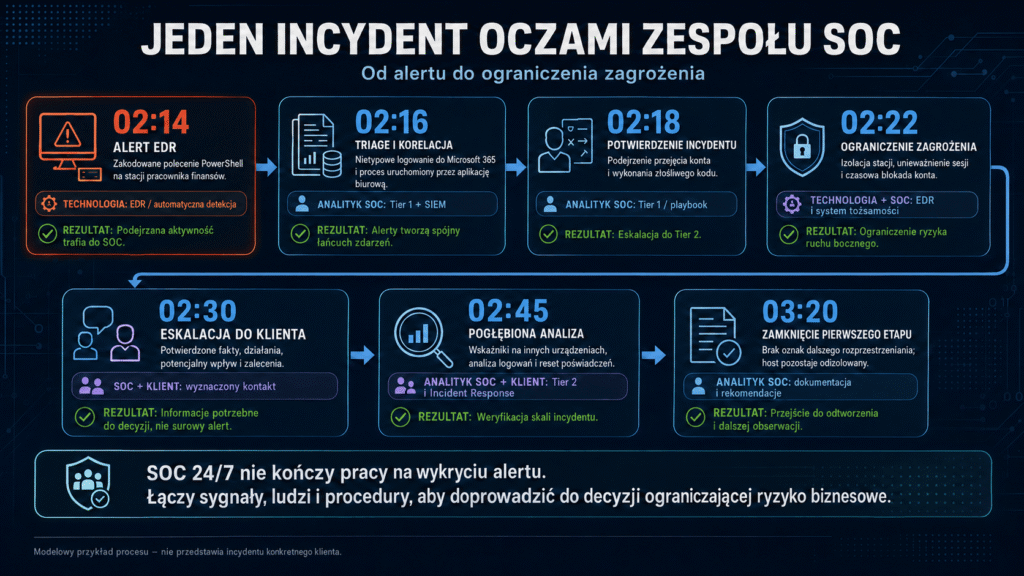
One incident through the SOC team’s eyes
The following is an illustrative scenario showing how tools, analysts and procedures work together, not a real incident involving a specific client.
02:14—first alert
EDR detects an encoded PowerShell command on a finance employee’s workstation. It could be a legitimate script, but the rule sends a risk signal to the SOC.
02:16—correlation and triage
Tier 1 checks the user, device and earlier activity. SIEM shows a Microsoft 365 sign-in from an unusual location, while EDR shows a process launched by an office application. The signals form a coherent chain.
02:18—incident confirmation
The event is classified as suspected account compromise and malicious code execution. Because financial assets are accessible, a playbook and Tier 2 escalation are activated.
02:22—threat containment
The workstation is isolated through EDR, sessions revoked and the account temporarily blocked. The SOC preserves data for analysis. This limits lateral movement but does not end the investigation.
02:30—client escalation
The client contact receives the classification, confirmed facts, actions taken, potential impact and recommendations—information for decisions, not a raw alert.
02:45—in-depth analysis and incident response
Tier 2 searches other devices for the same indicators and analyses sign-ins and network access. The client confirms the user did not perform these actions. Credential resets and review of remaining sessions begin.
03:20—first stage completed
No further spread is detected. The host remains isolated pending cleanup or recovery. The SOC records a timeline and recommendations, and monitors the incident until the workstation and account are safely restored.
Which technologies work in the background?
SOC technologies play different roles. None replaces the entire process.
| Technology or system | Role in the SOC | What it does not provide alone |
|---|---|---|
| EDR/XDR | Records and detects suspicious endpoint activity; XDR also combines data from other domains | Does not know the full business context or organisational escalation rules |
| SIEM | Centralises and correlates logs and alerts from multiple sources | Does not guarantee data quality, suitable rules or human response |
| SOAR | Automates repetitive steps, alert enrichment and selected response actions | Should not make unrestricted decisions affecting the business without oversight and agreed rules |
| Threat Intelligence | Provides context on known threats, techniques, domains, addresses and campaigns | Does not automatically confirm that an event is an incident |
| Ticketing / case management | Organises ownership, status, communications, evidence and timelines | Does not perform technical analysis |
| Communication and reporting tools | Enable escalation, notifications and recommendations | Do not replace agreed contacts, SLAs and responsibilities |
Automation works well for repetitive context collection. Disconnecting a critical system, however, may stop sales, production or customer service. The SOC therefore agrees which actions are automatic, which require approval and which belong to the system owner.
Why a SOC operates 24/7
Cyber threats do not respect working hours. An attacker may deliberately exploit reduced availability of administrators and decision-makers.
24/7 operation requires an entire model, not just an analyst on duty:
- shift handovers without losing context,
- clear priorities and response times,
- current contact details,
- client on-call coverage for critical escalations,
- permissions and response playbooks,
- documentation that enables analysis to continue.
An alert seen at 02:14 but left uninterpreted until 08:00 does not provide genuine 24/7 detection. The system ran continuously; the security process did not.
MTTD and MTTR—detection and response times—therefore matter. Low MTTD is insufficient if nobody decides, while action without analysis can cause unnecessary downtime. The SOC should shorten both while remaining proportionate.

What distinguishes a modern SOC from ordinary monitoring?
Monitoring provides visibility. A SOC uses it to assess threats and organise response. The difference is accountability for the process outcome.
| Traditional monitoring | Modern 24/7 SOC |
|---|---|
| Collects data and checks defined thresholds | Analyses activity in the context of users, assets and risk |
| Sends an alert | Verifies whether the alert indicates an incident |
| Shows an individual event | Correlates signals from multiple sources |
| Reports that a problem occurred | Classifies, escalates and coordinates response |
| Focuses on tool availability | Focuses on detecting and handling incidents |
| Stops after sending a notification | Documents the sequence, recommends changes and improves detection |
| Is primarily a technical function | Combines technology, people, processes and accountability |
Monitoring is the foundation of visibility, but not a complete protection capability if an alert is not followed by analysis, a decision and a response.
Likewise, deploying SIEM does not create a SOC. Someone must maintain sources, develop detection, verify alerts and initiate actions. We explore this in SIEM in your company — why deployment alone does not improve security.
How a SOC works with the client
A SOC operates within the organisation’s processes, using its data and agreed responsibilities. The quality of cooperation therefore affects service effectiveness.
Onboarding and responsibilities
Initially, critical systems, owners, data sources, contact channels and incident types are identified. SOC actions, isolation approvals and overnight escalation are agreed.
Day-to-day operations
An incident update should answer five questions:
- What was detected?
- Which facts have been confirmed?
- Which users, devices or services are affected?
- What has already been done?
- What decision or action is required from the client?
Escalation and incident response
During a critical incident, the SOC works with IT, system owners and the crisis team, and where needed legal, compliance and communications. The SOC provides technical analysis and coordination, while the client makes business decisions.
The complete containment, eradication and recovery process is described in Incident Response — responding to a cyberattack step by step.
Reporting and continuous improvement
Reports should cover major incidents, handling times, risk sources, trends and recommendations. Findings inform rule tuning, additional telemetry and playbook updates.
This is VigilHorizon’s approach: SOC 24/7 is an operational service, not another dashboard for sale. The benchmark is the organisation’s ability to detect, understand and contain incidents, including when the internal team is not working.
Summary
A modern 24/7 SOC is more than a room full of screens. It combines telemetry, technology, analyst expertise, automation, playbooks and clear accountability.
Its value emerges on the path from alert to decision: enriching the signal, correlating it, assessing organisational context and translating findings into proportionate action.
VigilHorizon views the SOC as part of the client’s operations, with agreed escalation, incident response support, reporting and continuous improvement. Technology accelerates analysis, while people, process and accountability create practical protection.
If you are unsure who analyses overnight alerts, how long detection-to-action takes or whether a critical incident will trigger a predictable process, assess readiness before the first serious event. Talk to VigilHorizon experts about your requirements and a 24/7 SOC model tailored to your environment.
Frequently asked questions (FAQ)
How does a SOC work?
A SOC collects and correlates data from security systems, networks, endpoints, identity, cloud and applications. Analysts validate alerts, assess risk, classify incidents, activate playbooks and coordinate escalation and response.
Does a SOC operate around the clock?
A 24/7 SOC operates continuously, including weekends and holidays. This means available analysts, procedures, contact channels and escalation mechanisms, not just running tools.
Does a SOC replace an IT administrator?
No. A SOC primarily handles detection, analysis and coordination of threat response. Administrators know the environment, maintain systems and perform the organisation’s operational tasks. The two roles should work together.
Does every company need its own SOC?
Not every organisation needs to build its own centre. SOC as a service or a hybrid model may be appropriate. What matters is consistent analysis and response capability proportionate to risk, system criticality and organisational requirements.
How does a SOC differ from monitoring?
Monitoring collects data and flags events. A SOC validates alerts, correlates them with other signals, assesses business significance, classifies incidents and initiates response. Monitoring provides visibility; the SOC participates in handling the threat.
Is SIEM the same as a SOC?
No. SIEM is a platform for collecting, searching and correlating logs. A SOC is an operating model covering people, processes, tools and accountability. SIEM may be a major component, but does not provide analysis and response by itself.
How quickly does a SOC respond to an alert?
Timing depends on priority, detection confidence and the SLA. Measure not only when an alert is noticed, but also the time to a decision and containment.
How does a SOC reduce false positives?
It enriches alerts with context, correlates sources and tunes rules, reducing noise while retaining the ability to detect genuine threats.
What data should be provided to the SOC?
Typically endpoint, identity, network, email, cloud and critical application data. Complete telemetry from critical assets is the priority.
How should SOC effectiveness be measured?
Measure detection and response times, escalation quality, critical system coverage and implementation of recommendations. Alert numbers alone do not show effectiveness.
Learn more:
- What is SOC 24/7? How a Security Operations Center works and why monitoring is not enough
- SIEM in your company — why deployment alone does not improve security
- EDR, XDR and MDR — how they differ and when they protect your business
- MTTD and MTTR — why detection time determines incident impact
- Incident Response — responding to a cyberattack step by step
Related articles



Not sure which plan is right for your business?
Complete a short questionnaire
Complete the form and we will help you select monitoring, incident handling or availability support for your organisation. We will agree the scope and service conditions before work begins.